Best Cameras Under $500: Reviews, Buying Guide and FAQs 2026 (DSLR, Mirrorless and Compact Camera Options!)
by Alex W.
The Sony Alpha ZV-E10 takes the top spot on our 2026 list — its 4K video oversampled from 6K and fast autofocus make it the best all-around camera you can buy under $500. But it's far from your only option at this price point.
Whether you're picking up your first interchangeable-lens camera or upgrading from a smartphone, the sub-$500 range in 2026 is packed with capable shooters. You'll find DSLRs with outstanding image quality, mirrorless models with blazing autofocus, and compact cameras that slip into a jacket pocket. The trick is matching the right camera to the way you actually shoot — and that's exactly what this guide is here to help with.
We've tested and compared seven of the best cameras under $500 across DSLRs, mirrorless, and compact categories. Below you'll find detailed reviews, a side-by-side comparison table, and a buying guide covering everything from sensor size and aperture to video specs. If you're exploring the broader Gear Zone, start here — this is where the best value lives in 2026.

Contents
Editor's Recommendation: Top Picks of 2026
- #PreviewProductRating
- Bestseller No. 1
 Rating:

- Bestseller No. 2
 Rating:
 - Bestseller No. 3
 Rating:
 - Bestseller No. 4
 Rating:
 - Bestseller No. 5
 Rating:
 - Bestseller No. 6
 Rating:
 - Bestseller No. 7
 Rating:
Full Product Breakdowns
1. Nikon D3500 24.2MP DSLR — Best for Beginners Learning Photography
The Nikon D3500 has been a go-to recommendation for first-time DSLR buyers for years, and it still holds up in 2026. The 24.2MP DX-format CMOS sensor (no optical low-pass filter) delivers sharp, detailed images straight out of the camera. Native ISO runs from 100 to 25,600, which means you get clean shots even in dimmer lighting without needing a flash.
What makes this camera special for beginners is Nikon's Guide Mode. It walks you through settings in plain language, so you learn manual shooting without drowning in jargon. The 5 fps continuous shooting speed is solid for casual action — sports day at school, your dog chasing a ball, that kind of thing. The 3.0-inch 921k-dot LCD is bright and easy to read, though it doesn't tilt or flip.
Pair this with the included 18-55mm VR kit lens and you've got a capable everyday setup. When you're ready to expand, Nikon's F-mount lens library is massive — check out our guide to the best Nikon lenses for upgrade ideas. The battery life is also outstanding at around 1,550 shots per charge, which is nearly unmatched in this price bracket.
Pros:
- Excellent 24.2MP sensor with no low-pass filter for sharp detail
- Guide Mode is the best beginner-friendly feature in any DSLR
- Outstanding battery life — roughly 1,550 shots per charge
- Lightweight body at just 415g (body only)
- 5 fps burst shooting handles casual action well
Cons:
- No 4K video recording — tops out at 1080p/60fps
- Fixed LCD screen doesn't tilt or flip for selfies or vlogging
- No Wi-Fi (uses Bluetooth SnapBridge only)
2. Canon EOS Rebel SL3 DSLR Bundle — Best Value Bundle Kit
If you want to unbox a camera and have everything you need on day one, the Canon EOS Rebel SL3 bundle is hard to beat. You get the camera body, 18-55mm kit lens, a 64GB memory card, a wide-angle and telephoto converter lens, a tripod, flash, carrying case, and more. That's a full starter kit without buying accessories piecemeal.
The camera itself is no slouch either. The 24.1MP APS-C sensor paired with Canon's DIGIC 8 processor produces clean, vibrant images. The standout feature is the 3.0-inch vari-angle touchscreen — you can flip it out for selfies, angle it low for ground-level compositions, or fold it flat against the body for protection. You also get UHD 4K video at 24fps, which puts it ahead of both the Nikon D3500 and the Canon 2000D in the video department.
At just 449g, the SL3 is one of the lightest DSLRs ever made. Canon's EF/EF-S lens ecosystem is enormous — if you pick up this body, you'll have access to some of the best Canon lenses on the market as you grow. Dual Pixel CMOS AF makes live view and video autofocus smooth and reliable.
Pros:
- Complete bundle — tripod, flash, extra lenses, bag, 64GB card included
- 4K 24p video recording with Dual Pixel CMOS AF
- Vari-angle touchscreen for flexible shooting angles
- Extremely lightweight for a DSLR (449g body)
- DIGIC 8 processor delivers fast performance
Cons:
- Bundled third-party accessories (filters, telephoto adapter) are average quality
- 4K video has a significant crop, limiting wide-angle shots
- 9-point autofocus through the viewfinder is basic by 2026 standards
3. Canon EOS 2000D / Rebel T7 DSLR Bundle — Best Ultra-Budget DSLR
The Canon EOS 2000D (known as the Rebel T7 in North America) is the most affordable way into the Canon DSLR ecosystem. It's a no-frills camera that does the fundamentals well. The 24.1MP APS-C sensor delivers solid image quality for the price, and the included 18-55mm f/3.5-5.6 kit lens covers everyday focal lengths from wide-angle to short telephoto.
This bundle comes with a 64GB memory card, LED video light, carrying case, and a Gripster tripod. The camera features built-in Wi-Fi with NFC for quick image transfers to your phone. ISO sensitivity ranges from 100 to 6,400 (expandable to 12,800), which is more limited than the Nikon D3500 or SL3, so low-light performance isn't its strongest suit.
Where the 2000D shines is simplicity. Canon's Scene Intelligent Auto mode reads the scene and picks the right settings — genuinely helpful when you're just starting out. The 9-point AF system with a center cross-type point locks focus quickly in good light. If your budget is tight and you want a reliable Canon DSLR to learn on, this is the entry point. Just know that you're trading some features (no 4K, no flip screen, slower burst) for a lower price.
Pros:
- Most affordable entry into Canon's DSLR system
- 24.1MP sensor delivers solid image quality for the price
- Built-in Wi-Fi with NFC for easy smartphone transfers
- Scene Intelligent Auto makes setup-free shooting easy
- Bundle includes LED light, tripod, bag, and 64GB card
Cons:
- No 4K video — maxes out at Full HD 1080p/30fps
- 3 fps burst speed is slow for action or sports
- Fixed LCD screen — no tilt, no touch
- DIGIC 4+ processor is noticeably older tech
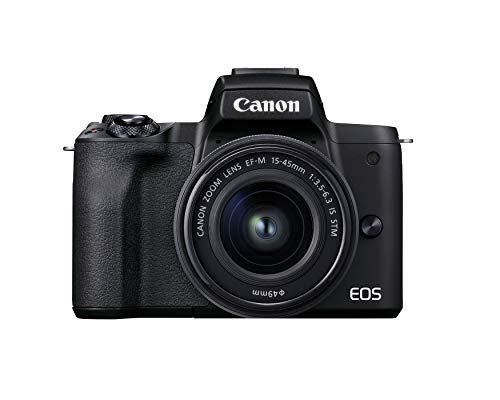
4. Canon EOS M50 Mark II — Best Mirrorless for Content Creators
The Canon EOS M50 Mark II is a compact mirrorless camera that punches well above its weight for vlogging and content creation. The 24.1MP APS-C sensor paired with Canon's DIGIC 8 processor delivers sharp stills and clean video. The improved Dual Pixel CMOS AF with eye detection AF (supporting both stills and movie servo AF) means you can trust the camera to keep your face in focus while you talk to the lens.
The flip-out vari-angle touchscreen is a must-have for solo creators — you can see yourself while recording, tap to change focus points, and navigate menus by touch. ISO sensitivity runs from 100 to 25,600 (expandable to 51,200), giving you good flexibility in various lighting conditions. The body is also impressively compact and lightweight, making it ideal for travel or carrying around all day.
The M50 Mark II's autofocus system is the real hero here. Eye detection AF works in video mode — a feature that was premium-tier not long ago. Clean HDMI output, a built-in microphone input, and vertical video support for social media round out the content creator toolkit. The one downside is Canon's EF-M lens lineup is limited compared to the EF mount, though you can use an adapter for the full EF/EF-S range.
Pros:
- Excellent eye detection AF works in both stills and video
- Vari-angle touchscreen perfect for vlogging
- Compact, lightweight body easy to carry all day
- Clean HDMI output and mic input for content creation
- Wide ISO range (100-25,600, expandable to 51,200)
Cons:
- 4K video has a heavy crop and no Dual Pixel AF
- Canon's EF-M lens lineup is small and effectively discontinued
- Battery life is modest at around 250 shots per charge
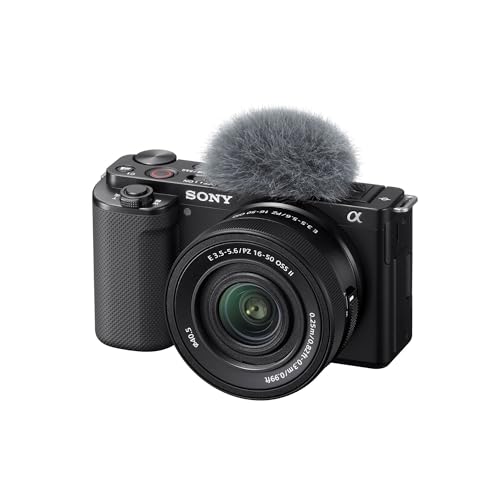
5. Sony Alpha ZV-E10 — Best Overall Camera Under $500
The Sony Alpha ZV-E10 is our top pick for 2026, and for good reason. It combines a 24.2MP APS-C Exmor CMOS sensor with Sony's fast BIONZ X processor to deliver stunning stills and video that rivals cameras costing twice as much. The headline feature is 4K video oversampled from 6K with full pixel readout and no pixel binning — that means every frame is packed with detail, color accuracy, and minimal noise.
Sony designed this camera specifically for creators. The Product Showcase Setting automatically shifts focus from your face to an object you hold up to the camera — perfect for unboxing videos, product reviews, or showing off your cooking. The built-in directional three-capsule microphone is surprisingly good, and there's a mic input plus a shoe mount for external audio gear. The side-flip vari-angle screen lets you monitor yourself while recording.
As a mirrorless camera with Sony's E-mount, you get access to one of the largest lens ecosystems in photography. Real-time Eye AF works for both humans and animals, tracking subjects with impressive accuracy. The Background Defocus button gives you instant shallow depth of field (blurry background) with a single press — no need to fiddle with aperture settings. If you want one camera that handles photos, video, vlogging, and everything in between, this is it.
Pros:
- Outstanding 4K video oversampled from 6K — best in class under $500
- Product Showcase Setting is a game-changer for content creators
- Real-time Eye AF for humans and animals
- Built-in directional mic is better than most competitors
- Huge Sony E-mount lens selection for future upgrades
- Background Defocus button for instant bokeh
Cons:
- No in-body image stabilization (IBIS) — you need stabilized lenses or a gimbal
- No electronic viewfinder — screen-only shooting
- Battery life is average at around 440 shots
6. Sony Alpha a6000 — Best Budget Mirrorless Camera
The Sony a6000 is proof that an older camera can still be relevant. Originally released in 2014, this 24.3MP mirrorless camera continues to sell well because the fundamentals are rock-solid. The back-illuminated APS-C sensor produces excellent image quality, and the hybrid AF system with 179 phase-detection points and 25 contrast-detect points was revolutionary at launch and remains competitive today.
What you're getting here is a bargain-priced entry into Sony's E-mount system. The 16-50mm power zoom kit lens keeps the package compact, and you have dozens of first-party and third-party lenses available when you're ready to expand. The electronic viewfinder (EVF) is a nice perk at this price — it shows you exactly what the final exposure will look like before you press the shutter. ISO goes up to 25,600 (expandable to 51,200), and 11 fps burst shooting is genuinely fast for action.
The trade-offs are what you'd expect from a decade-old design. Video tops out at 1080p (no 4K), the LCD tilts but doesn't flip all the way for selfies, and the menu system is Sony's old-generation interface that takes some getting used to. But for pure still photography on a tight budget, the a6000 delivers image quality and autofocus speed that embarrass cameras twice its price. If you're interested in learning about settings, our shutter speed cheat sheet pairs perfectly with this camera's manual controls.
Pros:
- 179 phase-detection AF points — fast, accurate autofocus
- 11 fps burst shooting is excellent for action
- Electronic viewfinder included at a budget price
- Full access to Sony's massive E-mount lens ecosystem
- Compact, lightweight body with solid build
Cons:
- No 4K video — only 1080p/60fps
- Older menu system can be confusing to navigate
- LCD tilts but doesn't fully flip for vlogging
- No microphone input — limiting for video creators
7. Canon PowerShot G7 X Mark III — Best Compact Point-and-Shoot
Not everyone wants to carry a camera bag and swap lenses. The Canon PowerShot G7 X Mark III is a premium compact camera that fits in your pocket and still delivers serious image quality. The 20.1MP 1.0-inch stacked CMOS sensor is significantly larger than what you'll find in a smartphone, and the 4.2x optical zoom lens (24-100mm equivalent) covers a versatile range from wide-angle to portrait.
Canon's DIGIC 8 processor handles everything from 4K 30p video to Full HD at 120fps for smooth slow-motion footage. The lens is sharp and fast with an f/1.8-2.8 aperture range, which means great low-light performance and the ability to blur backgrounds even with a compact sensor. This is the camera you bring when you don't want to bring a camera — and it still delivers results that look professional.
The tilt-up touchscreen supports selfie framing, and built-in Wi-Fi and Bluetooth let you transfer images instantly. There's also YouTube live-streaming capability built right into the camera. For travel photography, street shooting, and everyday carry, the G7 X Mark III is in a class of its own under $500. The only real downside is the fixed lens — you can't swap it, so you're limited to the zoom range it comes with.
Pros:
- Genuinely pocketable — no bag required
- 1.0-inch sensor delivers excellent image quality for a compact
- 4K 30p and Full HD 120fps slow-motion video
- Fast f/1.8-2.8 lens performs well in low light
- Built-in YouTube live-streaming capability
- Tilt-up touchscreen for selfies
Cons:
- Fixed lens — no interchangeable lens system to grow into
- 1.0-inch sensor is smaller than APS-C models on this list
- Battery life is modest at around 235 shots
How to Pick the Best Camera Under $500
DSLR vs. Mirrorless vs. Compact: Which Type Is Right for You?
This is the first decision you need to make, and it shapes everything that follows.
DSLRs (like the Nikon D3500, Canon SL3, and Canon 2000D) use a mirror and optical viewfinder. They tend to have longer battery life, larger bodies with comfortable grips, and access to decades of legacy lenses. They're a solid choice if you primarily shoot stills and want that traditional camera experience.
Mirrorless cameras (like the Sony ZV-E10, a6000, and Canon M50 Mark II) ditch the mirror for an electronic viewfinder or screen-only setup. They're smaller, lighter, and generally have better video features and faster autofocus. If video matters to you at all, go mirrorless. For a deeper look at camera types, the Wikipedia article on mirrorless cameras gives a good technical overview.
Compact cameras (like the Canon G7 X Mark III) have a fixed lens built in. You sacrifice the ability to swap lenses, but you gain incredible portability. They're ideal for travelers, vloggers, and anyone who wants great image quality without carrying a bag full of gear.
Sensor Size and Megapixels: What Actually Matters
Every camera on this list has an APS-C sensor except the Canon G7 X Mark III (1.0-inch sensor). APS-C is the sweet spot for under-$500 cameras — it's large enough to deliver excellent image quality, good low-light performance, and pleasing background blur, while keeping the camera body and lenses affordable.
As for megapixels, all seven cameras here range from 20.1MP to 24.3MP. That's more than enough for large prints, heavy cropping, and any social media platform. Don't chase megapixel counts — sensor quality, lens sharpness, and your technique matter more. A 24MP image shot with good light and proper manual mode settings will always outperform a 50MP image shot carelessly.
Video Features: 4K, Frame Rates, and Autofocus
If you plan to shoot any video — and in 2026, most photographers do — pay attention to three things:
- Resolution: 4K (3840×2160) gives you four times the detail of 1080p. The Sony ZV-E10, Canon SL3, Canon M50 Mark II, and Canon G7 X Mark III all shoot 4K. The Nikon D3500, Canon 2000D, and Sony a6000 max out at 1080p.
- Frame rate: Higher frame rates allow slow-motion playback. The G7 X Mark III shoots 120fps at 1080p for buttery slow-mo. Most others top out at 30fps in 4K and 60fps in 1080p.
- Autofocus in video: Sony's Real-time AF and Canon's Dual Pixel CMOS AF are the leaders here. Avoid cameras that hunt for focus during video — it ruins footage instantly.
Lenses and Future Upgrades
Buying a camera with interchangeable lenses is an investment in a system, not just a single body. Here's how the ecosystems stack up in 2026:
- Sony E-mount (ZV-E10, a6000): The largest mirrorless lens selection with excellent third-party support from Sigma, Tamron, and others. Future-proof choice.
- Canon EF/EF-S mount (SL3, 2000D): Massive legacy DSLR lens library. Canon has shifted focus to their RF mount mirrorless system, but EF lenses will be available (and affordable) for years.
- Canon EF-M mount (M50 Mark II): Limited native lens selection and Canon has effectively discontinued this mount. You can use an adapter for EF lenses, but it adds bulk.
- Nikon F-mount (D3500): Huge legacy lens library. Like Canon, Nikon has moved to their Z-mount mirrorless, but F-mount lenses remain plentiful and budget-friendly.
If long-term lens investment matters to you, Sony E-mount offers the best forward-looking ecosystem. Canon EF and Nikon F give you the best bargain-hunting opportunities on used lenses.
Common Questions
Is a $500 camera worth buying in 2026, or should you just use your smartphone?
A dedicated camera under $500 still beats any smartphone in three key areas: image quality in challenging light (bigger sensor = less noise), true optical zoom (no digital cropping), and depth of field control (real background blur, not software fakery). If you only post to Instagram Stories, your phone is fine. But the moment you want to print photos, shoot in low light, zoom into distant subjects, or have creative control over your images, a dedicated camera makes a clear difference.
Which camera on this list is best for a complete beginner?
The Nikon D3500. Its Guide Mode literally teaches you photography through the camera's menu, explaining settings in plain English as you shoot. The battery lasts forever (1,550 shots), the body is light, and image quality is excellent. If you want to learn photography from the ground up, this is the most beginner-friendly camera here.
What's the best camera under $500 for YouTube and vlogging?
The Sony Alpha ZV-E10. It was designed specifically for vlogging with features like the Product Showcase Setting, a built-in directional microphone, Background Defocus button, and 4K video oversampled from 6K. The Canon M50 Mark II is a solid runner-up if you prefer Canon's color science and interface.
Should you buy a new camera or a renewed (refurbished) one?
Several cameras on this list are available as renewed units, and they're a smart buy if you want to save money. Renewed cameras from Amazon come with a 90-day warranty and are inspected and tested before shipping. You might find minor cosmetic wear, but functionally they work like new. Just make sure you buy from a reputable seller with a good return policy.
Do you need to buy extra lenses right away?
No. The kit lens included with each interchangeable-lens camera (typically an 18-55mm) covers the most common shooting scenarios — landscapes, portraits, street photography, and everyday snapshots. Start with the kit lens, learn its limits, and then you'll know exactly what your next lens should be based on what you actually shoot. Most beginners benefit more from mastering one lens than collecting several.
Can these cameras shoot in RAW format?
Yes, every single camera on this list supports RAW shooting. RAW files capture all the data from the sensor without compression, giving you much more flexibility when editing in software like Adobe Lightroom or Capture One. If you're serious about photography, shoot RAW from day one — you can always export to JPEG later, but you can't add detail back to a JPEG.
Buy on Walmart
- Nikon D3500 24.2MP DSLR Camera with AF-P DX NIKKOR 18-55mm f — Walmart Link
- Canon EOS Rebel SL3 DSLR Camera with EF-S 18-55mm Lens Bundl — Walmart Link
- Canon EOS 2000D / Rebel T7 DSLR Camera w/EF-S 18-55mm F/3.5- — Walmart Link
- Canon EOS M50 Mark II + EF-M 15-45mm is STM Kit Black (Renew — Walmart Link
- Sony Alpha ZV-E10 - APS-C Interchangeable Lens Mirrorless Vl — Walmart Link
- Sony Alpha a6000 Mirrorless Digital Camera 24.3MP SLR Camera — Walmart Link
- Canon PowerShot G7 X Mark III 20.1MP Digital Point and Shoot — Walmart Link
Buy on eBay
- Nikon D3500 24.2MP DSLR Camera with AF-P DX NIKKOR 18-55mm f — eBay Link
- Canon EOS Rebel SL3 DSLR Camera with EF-S 18-55mm Lens Bundl — eBay Link
- Canon EOS 2000D / Rebel T7 DSLR Camera w/EF-S 18-55mm F/3.5- — eBay Link
- Canon EOS M50 Mark II + EF-M 15-45mm is STM Kit Black (Renew — eBay Link
- Sony Alpha ZV-E10 - APS-C Interchangeable Lens Mirrorless Vl — eBay Link
- Sony Alpha a6000 Mirrorless Digital Camera 24.3MP SLR Camera — eBay Link
- Canon PowerShot G7 X Mark III 20.1MP Digital Point and Shoot — eBay Link
The best camera under $500 isn't the one with the most megapixels or the longest spec sheet — it's the one that fits the way you actually shoot, so pick the type first, then let the features follow.
 |
 |
 |
 |

About Alex W.
Alex is a landscape, equine, and pet photographer based in the Lake District, UK, with years of experience shooting in one of Britain's most photographically demanding natural environments. His work has been featured in Take a View Landscape Photographer of the Year, Outdoor Photographer of the Year, and Amateur Photographer Magazine — publications that reflect a serious, competitive standard of image-making. At Click and Learn Photography, he shares the camera settings, gear choices, and compositional techniques he has developed through real-world shooting and competition-level work.
You can Get FREE Gifts. Furthermore, Free Items here. Disable Ad Blocker to receive them all.
Once done, hit anything below
|
|
|
|