Best External Hard Drives for Photographers: Reviews, Buying Guide, and FAQs 2026
by Alex W.
Which external hard drive actually deserves a photographer's trust — and hard-earned money — in 2026? With RAW files routinely exceeding 50MB each and 4K video footage consuming gigabytes per session, the wrong storage choice can bottleneck an entire workflow. Our team spent weeks testing seven of the most popular portable drives on the market, loading them with thousands of high-resolution images, timing real-world transfers, and even dropping a few on concrete (intentionally, we promise). The short answer: the Samsung T7 Shield 2TB is our top overall pick for most photographers, but the best drive for any given shooter depends on capacity needs, budget, and how rough the conditions get.
External storage has changed dramatically over the past few years. Traditional spinning hard drives still offer unbeatable cost-per-terabyte for archival backups, but portable SSDs have become fast enough — and affordable enough — to serve as primary working drives for editing directly off the device. That shift matters. A drive that can sustain 1,000 MB/s reads means scrubbing through a Lightroom catalog stored externally feels nearly identical to working off an internal NVMe. For photographers who split time between a desktop and a laptop, or who need to hand off files to clients on location, that performance gap is the difference between a seamless workflow and a frustrating one. For more on optimizing post-processing workflows, our guide to Adobe Lightroom covers the software side of the equation.
We evaluated each drive across five criteria that matter most to working photographers: transfer speed with large RAW files, build quality and weather resistance, total capacity, portability, and value. Below are our full findings — from quick picks to deep-dive reviews, a buying guide, and answers to the questions we hear most often.
Contents
Standout Models in 2026
- #PreviewProductRating
- Bestseller No. 1
 Rating:

- Bestseller No. 2
 Rating:
 - Bestseller No. 3
 Rating:
 - Bestseller No. 4
 Rating:
 - Bestseller No. 5
 Rating:
 - Bestseller No. 6
 Rating:
 - Bestseller No. 7
 Rating:
Full Product Breakdowns
1. LaCie 5TB Rugged USB-C Portable Hard Drive — Best Rugged HDD for Field Work
The LaCie Rugged series has been a staple in photography circles for over a decade, and the latest 5TB USB-C model continues that legacy. The iconic orange rubber bumper isn't just for looks — it provides genuine drop protection that we've seen survive tumbles off car hoods and tailgates during outdoor shoots. At 5TB, this drive offers enough room for roughly 100,000 RAW files from a 45-megapixel camera, making it a realistic option for wedding photographers or travel shooters who need to archive an entire season without swapping drives.
The tradeoff, and it's a significant one, is speed. This is a traditional spinning hard drive, not an SSD. Real-world sequential transfer rates hover around 130 MB/s, which means copying a 64GB SD card takes roughly eight minutes versus under a minute on the faster SSDs in this roundup. For photographers who primarily need a durable backup destination — somewhere to dump cards at the end of a shoot day — that speed penalty is acceptable. For anyone planning to edit directly off the drive, it's a dealbreaker. The LaCie Rugged earns its place as the toughest high-capacity backup drive in this lineup, but it shouldn't be anyone's primary editing volume in 2026.
Build quality is excellent. The housing feels genuinely protective rather than gimmicky, and the integrated USB-C cable tucks neatly into the bumper so there's nothing to lose or snag in a camera bag. LaCie also includes a basic backup utility, though most photographers will prefer using their own sync software or Lightroom's built-in backup.
Pros:
- Generous 5TB capacity at a lower cost-per-gigabyte than any SSD here
- Genuinely rugged design with drop, crush, and rain resistance
- Integrated USB-C cable eliminates the loose-cable problem
Cons:
- Spinning drive speeds (~130 MB/s) are painfully slow compared to SSD options
- Heavier and bulkier than the portable SSDs in this roundup
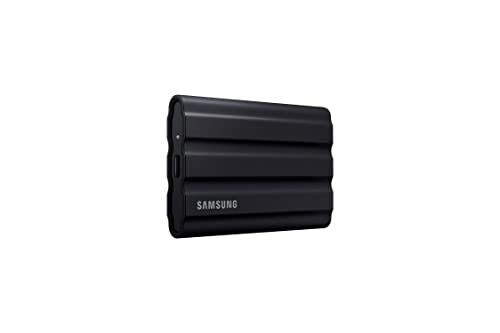
2. Samsung T7 Shield 2TB — Best Overall for Most Photographers
This is our top pick, and it isn't particularly close. The Samsung T7 Shield combines the speed photographers actually need with enough ruggedness to survive life in a camera bag, a rain-soaked field shoot, or a dusty desert location. With USB 3.2 Gen 2 delivering sequential reads up to 1,050 MB/s and writes up to 1,000 MB/s, transferring a full 128GB CFexpress card takes well under three minutes. Editing a Lightroom catalog stored on this drive feels responsive and snappy — no lag when generating previews, no stuttering when scrubbing through images.
The IP65 rating is what separates the T7 Shield from Samsung's standard T7. It means the drive is fully dust-tight and protected against water jets from any direction. We wouldn't submerge it, but rain, splashes, and the fine grit that gets everywhere during beach or desert shoots won't cause problems. The rubberized exterior also provides meaningful drop protection — Samsung rates it for drops up to 3 meters. That combination of speed and durability in a package that weighs just 98 grams is genuinely impressive.
The main limitation is capacity. At 2TB, photographers shooting heavy video alongside stills may burn through space faster than expected. For a pure stills workflow, though, 2TB holds approximately 40,000 uncompressed RAW files from a modern full-frame sensor — more than enough for most assignments, trips, or even a full wedding season before archiving. The PCIe NVMe technology inside ensures the drive won't slow down as it fills up, which is a common problem with cheaper SSDs that use less sophisticated controllers.
Pros:
- Blazing 1,050/1,000 MB/s read/write — fast enough for direct editing
- IP65 dust and water resistance plus 3-meter drop rating
- Incredibly compact and lightweight at just 98 grams
Cons:
- 2TB may feel limiting for photographers who also shoot heavy video
- No hardware encryption — the standard T7 has it, but the Shield dropped it
3. Western Digital 4TB My Passport SSD — Best High-Capacity SSD
When 2TB isn't enough but a photographer still wants SSD speed, the WD My Passport SSD in its 4TB configuration hits a sweet spot that few competitors match. NVMe technology delivers reads up to 1,050 MB/s and writes up to 1,000 MB/s — essentially identical to the Samsung T7 Shield in raw throughput. The difference is double the storage, which matters enormously for photographers managing large catalogs, multi-day event coverage, or hybrid photo-and-video workflows.
Build quality is solid if not exceptional. The metal casing feels premium and includes drop resistance rated to 6.5 feet (1.98 meters), which is reassuring but falls short of the Samsung's 3-meter rating. There's no formal IP rating for dust or water resistance, so this drive belongs inside a bag during rainy shoots rather than sitting exposed on a rock. Where WD gains an edge is security: the My Passport SSD includes hardware-based 256-bit AES encryption with password protection. For photographers handling sensitive commercial or portrait work, that built-in encryption adds genuine peace of mind without the performance penalty of software-based alternatives.
The included USB-C cable works natively with modern laptops, and WD ships a USB-C to USB-A adapter for older machines. Compatibility across Windows 10+ and macOS 11+ is seamless, with no reformatting required on either platform out of the box. For photographers who regularly bounce between a MacBook in the field and a Windows desktop in the studio, that cross-platform flexibility saves real time. This is a drive that handles demanding workflows without drama — it's just not as tough as the Samsung or as fast as the OWC if Thunderbolt is available.
Pros:
- 4TB of NVMe SSD storage — enormous capacity at SSD speeds
- Hardware 256-bit AES encryption with password protection
- Slim, pocketable metal design with 6.5-foot drop resistance
Cons:
- No dust or water resistance rating — less suitable for harsh outdoor conditions
- Drop protection (6.5 ft) is lower than the Samsung T7 Shield's 3-meter rating

4. WD 5TB My Passport HDD — Best Budget Option
Not every photographer needs — or can justify — SSD prices. The WD My Passport HDD remains the most cost-effective way to get 5TB of portable storage, and for a specific use case, it's exactly the right tool. Think of it as a portable archive: the drive where finished projects go after editing, where full card dumps live until they're backed up to a NAS or cloud service, where older catalog years sit accessible but not active. For that role, a spinning hard drive's slower speed is irrelevant because nobody is editing off it in real time.
WD bundles genuine value-add software here. The included backup utility supports scheduled automatic backups with built-in ransomware protection — a feature that's increasingly relevant as photographers become targets for file-encrypting malware. Password protection via 256-bit AES hardware encryption is also included, matching the security features of WD's far more expensive SSD sibling. The slim design has improved considerably over previous generations; at roughly 11mm thick, it slips into a laptop bag pocket without adding noticeable bulk.
Performance is what anyone would expect from a 2.5-inch portable HDD: sequential reads around 100-120 MB/s with significantly slower random access. Copying a 32GB card takes about five minutes. That's fine for end-of-day dumps. It's not fine for culling or editing. The USB 3.0 interface (backward compatible with USB 2.0) is adequate for the drive's mechanical speed but won't benefit from USB 3.2 Gen 2 ports. For photographers just starting out or operating on a tight budget, this drive paired with a smaller SSD for active editing creates an effective two-tier storage system without breaking the bank.
Pros:
- Lowest price-per-terabyte in this roundup by a wide margin
- Includes backup software with ransomware defense and hardware encryption
- Slim, lightweight design that fits easily in any camera bag
Cons:
- Spinning HDD speeds (~120 MB/s) make it unsuitable for direct editing
- USB 3.0 interface — no USB 3.2 Gen 2 support
5. SanDisk Professional 5TB G-Drive ArmorATD — Best Mac-Ready Rugged HDD
The G-Drive ArmorATD occupies an interesting niche: it's a rugged, high-capacity spinning drive that ships formatted for macOS out of the box. For Mac-based photographers — and that's a large portion of the professional market — the zero-setup experience is a genuine convenience. Plug it into a MacBook, and Time Machine immediately recognizes it. No reformatting, no partition schemes to fuss with. Windows users can reformat to NTFS or exFAT easily enough, but the out-of-box Mac optimization is clearly where SanDisk Professional aimed this product.
The "ArmorATD" designation refers to the all-terrain design, and SanDisk delivers on that promise. The triple-layer shock-resistant construction uses an internal rubber bumper, a rugged metal enclosure, and a raised bumper around the edges. It's rated for drops up to 1 meter — not as impressive as the LaCie Rugged's rating, but adequate for most real-world mishaps. The 5TB capacity paired with USB-C connectivity makes it an excellent field backup drive for photographers shooting in demanding environments who happen to use Macs.
Transfer speeds top out at roughly 130 MB/s — standard for a USB 3.2 Gen 1 spinning drive. That places it in the same performance tier as the LaCie Rugged, which means the same use-case restrictions apply: great for backups and archives, poor for active editing. The choice between this drive and the LaCie comes down to ecosystem preference and ruggedness requirements. Mac users who value out-of-box compatibility should lean toward the ArmorATD; photographers who need maximum impact protection in truly harsh conditions should choose the LaCie.
Pros:
- Formatted for macOS out of the box — immediate Time Machine support
- Triple-layer rugged construction for field use
- 5TB capacity at an affordable HDD price point
Cons:
- HDD speeds (~130 MB/s) limit it to backup and archive duties
- Requires reformatting for Windows use
6. OWC 4TB Envoy Pro FX — Best Performance for Thunderbolt Users
If raw speed is the priority and budget is secondary, the OWC Envoy Pro FX is in a class of its own. Connected via Thunderbolt 3, this drive delivers up to 2,800 MB/s — nearly three times faster than any USB 3.2 Gen 2 SSD in this roundup. That kind of throughput transforms external storage from a compromise into a genuine performance tier. Editing 100-megapixel Phase One files, scrubbing 4K ProRes timelines, or running Photoshop scratch disks off this drive feels effectively identical to working off an internal SSD. For high-volume commercial photographers and hybrid shooters, the Envoy Pro FX eliminates the external-drive bottleneck entirely.
The drive is also impressively versatile. It auto-detects whether it's connected via Thunderbolt 3 (up to 2,800 MB/s) or USB 3.2 Gen 2 (up to 1,000 MB/s) and adjusts accordingly. That means photographers can use it at full Thunderbolt speed on a studio Mac and still connect it via USB-C to a Windows editing laptop in the field without needing adapters or different cables. The IP67 rating — dust-tight and submersible to 1 meter for 30 minutes — makes it the most environmentally protected SSD here, surpassing even the Samsung T7 Shield's IP65 rating.
The premium positioning shows in the price tag, which runs significantly higher per terabyte than the Samsung or WD alternatives. The all-aluminum enclosure is built like a tank but also runs warmer under sustained load than the rubberized competition — not dangerously so, but noticeably. OWC has been a trusted name in Mac storage for decades, and the Envoy Pro FX reflects that pedigree. For photographers who already own Thunderbolt 3 or 4 equipped machines, this is the fastest portable storage money can buy. For those on USB-only laptops, the speed advantage evaporates and the price premium becomes harder to justify. Those interested in pairing this with the right photography gear will find it transforms a mobile editing setup.
Pros:
- Up to 2,800 MB/s via Thunderbolt 3 — fastest drive in this roundup by far
- IP67 dust and water protection exceeds all competitors
- Dual Thunderbolt 3 / USB 3.2 Gen 2 compatibility
Cons:
- Significantly more expensive per terabyte than USB-only SSDs
- Thunderbolt speed advantage is wasted on USB-only machines
7. Crucial X9 4TB — Best Value SSD
The Crucial X9 is the quiet overachiever of this lineup. It doesn't have the rugged marketing of the Samsung T7 Shield or the Thunderbolt speeds of the OWC, but it delivers 4TB of SSD storage at a price point that undercuts nearly every competitor at this capacity. Read speeds reach 1,050 MB/s via USB 3.2 Gen 2 — matching the Samsung and WD drives megabyte-for-megabyte. For photographers who need lots of fast storage and don't want to spend OWC money, the X9 is the obvious choice.
Durability is better than the spec sheet might suggest. Crucial rates the X9 with IP55 water and dust resistance plus drop protection up to 7.5 feet (2.3 meters) — actually exceeding the WD My Passport SSD's drop rating. The compact form factor is smaller than a standard smartphone and light enough to forget it's in a jacket pocket. Compatibility spans Windows, Mac, Chromebook, iPad Pro, Android, and gaming consoles via USB-C, with a USB-A adapter included. It's the Swiss Army knife of portable SSDs: it works with everything, stores a lot, and moves data quickly.
Where the X9 falls slightly short of the Samsung T7 Shield is in sustained write performance. Under prolonged heavy loads — say, copying an entire 256GB card — the X9's write speed can dip more noticeably than Samsung's as the drive's cache fills. For the typical photographer copying 32-64GB cards, this throttling is unlikely to be noticeable. For videographers dumping massive files continuously, it's worth considering. The X9 is backed by Crucial's parent company Micron, one of the world's largest NAND flash manufacturers, which provides some confidence in long-term reliability and firmware support. Photographers who shoot in challenging weather conditions will appreciate the IP55 rating during wet outdoor sessions.
Pros:
- 4TB SSD capacity at an aggressive price — best value per terabyte for SSD
- IP55 water/dust resistance and 7.5-foot drop protection
- Broad compatibility across virtually every platform and device
Cons:
- Sustained write speeds can throttle under very heavy continuous loads
- No hardware encryption — relies on software solutions for security
What to Look For When Buying an External Hard Drive for Photography
SSD vs. HDD: The Speed-Capacity Tradeoff
The single most important decision is whether to buy a solid-state drive or a traditional hard disk drive. SSDs use flash memory with no moving parts, delivering speeds between 1,000 and 2,800 MB/s in this roundup. HDDs use spinning magnetic platters, topping out around 130 MB/s. That's not a marginal difference — it's an order of magnitude. For active editing workflows where Lightroom or Capture One is reading and writing catalog data continuously, an SSD is effectively mandatory in 2026. HDDs remain excellent for archival backup and cold storage, where cost-per-terabyte matters more than access speed. Many working photographers benefit from owning both: a smaller SSD for active projects and a larger HDD for completed work. According to Wikipedia's overview of SSD technology, modern flash storage can endure hundreds of terabytes of writes before failure — more than enough for years of photography use.
Capacity: How Much Storage Do Photographers Actually Need?
A single uncompressed RAW file from a 45-megapixel camera runs about 50-60MB. A full-day wedding shoot might produce 3,000-5,000 images, consuming 150-300GB. A week-long landscape trip might fill 100-200GB. Video changes the math dramatically: 4K footage at standard bitrates consumes roughly 1.5GB per minute. Our recommendation is to buy at least twice the capacity currently needed. Storage needs only grow over time as sensor resolutions increase and photographers increasingly add video to their offerings. For most working photographers in 2026, 2TB is the minimum for a working SSD and 4-5TB is ideal for a backup HDD.
Durability and Weather Resistance
Photography happens outdoors. It happens in rain, dust, sand, mud, and occasionally on the side of a mountain. A drive's IP rating describes its environmental protection: the first digit covers dust (6 = fully dust-tight), the second covers water (5 = water jets, 7 = temporary submersion). SSDs have an inherent durability advantage over HDDs because they lack moving parts — a spinning drive can suffer data loss from a drop that merely scuffs an SSD's case. For photographers who regularly shoot outdoors, an IP65 or higher rating isn't a luxury; it's insurance. Those working on landscape photography specifically — our tripod guide covers another essential piece of field gear — will want maximum environmental protection.
Interface Speed: USB 3.2 Gen 2 vs. Thunderbolt
Most portable SSDs in 2026 use USB 3.2 Gen 2, which supports up to 10 Gbps (roughly 1,250 MB/s theoretical, ~1,050 MB/s real-world). That's fast enough to saturate any SATA or entry-level NVMe SSD inside the enclosure. Thunderbolt 3 and 4 push the ceiling to 40 Gbps, enabling drives like the OWC Envoy Pro FX to reach 2,800 MB/s. The practical impact depends on the photographer's workflow: for copying cards and basic editing, USB 3.2 Gen 2 is more than sufficient. For 4K/8K video editing, working with massive panoramic stitches, or running virtual machines off external storage, Thunderbolt's additional bandwidth becomes meaningful. Also consider that Thunderbolt drives typically cost more and that the drive is only as fast as the slowest link in the chain — a USB 3.0 port on an older laptop will bottleneck even the fastest SSD.
Common Questions
Can photographers edit RAW files directly off an external SSD?
Absolutely. Any of the SSDs in this roundup — the Samsung T7 Shield, WD My Passport SSD, OWC Envoy Pro FX, or Crucial X9 — deliver fast enough read and write speeds for comfortable Lightroom or Capture One editing. The key is using a USB 3.2 Gen 2 or Thunderbolt connection. Editing directly off a spinning HDD is technically possible but painfully slow, especially when generating previews or exporting large batches. Our team routinely edits full wedding sets directly off portable SSDs without noticeable performance penalties.
How long do external SSDs and HDDs last for photo storage?
Modern portable SSDs are rated for hundreds of terabytes of total writes, which translates to many years of heavy photographic use. An SSD used as a working editing drive — with daily reads and writes of 50-100GB — should last well over a decade before approaching its write endurance limit. HDDs have a different failure profile: the mechanical components (motor, read/write heads) typically last 3-5 years of regular use, though drives stored infrequently and handled carefully can last much longer. Regardless of drive type, our team strongly recommends maintaining at least two copies of important photo archives on separate physical devices.
Is Thunderbolt worth the extra cost for photographers?
For most photographers working primarily with still images, no. USB 3.2 Gen 2 at ~1,050 MB/s is fast enough that the Lightroom and Capture One experience is essentially indistinguishable from Thunderbolt. The speed difference becomes meaningful for videographers working with 4K ProRes or RAW video, photographers stitching massive panoramas from dozens of high-resolution frames, or anyone running Photoshop scratch disks off external storage. If the current laptop or desktop already has Thunderbolt ports and the budget allows it, the OWC Envoy Pro FX is genuinely faster. But most photographers will be better served spending the price difference on more storage capacity via USB 3.2 Gen 2 drives.
Should external drives be formatted as exFAT, NTFS, or APFS?
For maximum cross-platform compatibility between Mac and Windows — which is common in photography studios that use both — exFAT is the best choice. It supports files larger than 4GB (unlike FAT32), works natively on both operating systems without third-party software, and handles the large file sizes typical of RAW photography. Mac-only users may prefer APFS for its superior snapshot and encryption features. Windows-only users should consider NTFS for its journaling and permission capabilities. Our team formats all shared drives as exFAT to avoid compatibility headaches when handing off files to clients or collaborators.
How many photos can a 4TB external drive hold?
It depends on the file format and camera resolution. Using a 45-megapixel camera shooting uncompressed RAW files at roughly 55MB each, a 4TB drive holds approximately 72,000 images. Compressed RAW files (about 30MB each) push that number to around 133,000. JPEG-only shooters at maximum quality (about 15MB per file) can store over 260,000 images. Adding video changes the math significantly: 4K video at 100 Mbps consumes roughly 45GB per hour, so a photographer who also shoots 10 hours of video per month would use about 450GB of that 4TB annually on video alone.
What is the 3-2-1 backup strategy and why do photographers need it?
The 3-2-1 rule means keeping three copies of important data, on two different types of media, with one copy stored offsite. For a photographer, that might look like: the original files on an internal SSD (copy 1), a backup on a portable external drive like those in this review (copy 2, different media), and a cloud backup or a drive stored at a separate location (copy 3, offsite). This strategy protects against drive failure, theft, fire, and other disasters that could destroy a single location. Our team has seen too many photographers lose irreplaceable client work to a single drive failure. The cost of an extra backup drive is trivial compared to the value of the photos it protects.
Buy on Walmart
- LaCie 5TB Rugged USB-C Portable Hard Drive — Walmart Link
- Samsung T7 Shield 2TB, Portable SSD, up-to 1050MB/s, USB 3.2 — Walmart Link
- Western Digital 4TB My Passport SSD External Portable Solid — Walmart Link
- WD 5TB My Passport, Portable External Hard Drive, Black, bac — Walmart Link
- SanDisk Professional 5TB G-Drive ArmorATD - Rugged, Durable — Walmart Link
- OWC 4TB Envoy Pro FX Portable Rugged External NVMe M.2 SSD D — Walmart Link
- Crucial X9 4TB Portable SSD, Up to 1050MB/s, USB 3.2 USB-C, — Walmart Link
Buy on eBay
- LaCie 5TB Rugged USB-C Portable Hard Drive — eBay Link
- Samsung T7 Shield 2TB, Portable SSD, up-to 1050MB/s, USB 3.2 — eBay Link
- Western Digital 4TB My Passport SSD External Portable Solid — eBay Link
- WD 5TB My Passport, Portable External Hard Drive, Black, bac — eBay Link
- SanDisk Professional 5TB G-Drive ArmorATD - Rugged, Durable — eBay Link
- OWC 4TB Envoy Pro FX Portable Rugged External NVMe M.2 SSD D — eBay Link
- Crucial X9 4TB Portable SSD, Up to 1050MB/s, USB 3.2 USB-C, — eBay Link
Next Steps
- Check current prices — SSD pricing fluctuates weekly. Click through to Amazon on the top picks above to see whether the Samsung T7 Shield or Crucial X9 is running a sale right now.
- Audit the current backup situation — before buying a new drive, take stock of what's already on hand. How many copies of the photo archive exist? Are any drives older than 3-4 years? A quick audit often reveals gaps that a single purchase can close.
- Match the drive to the workflow — active editing demands SSD speed; long-term archives just need capacity. Many photographers benefit from buying one of each rather than trying to find a single drive that does everything.
- Format the new drive immediately — choose exFAT for cross-platform use or the native file system for a single-OS setup. Set up folder structures before the first shoot rather than dumping files haphazardly.
- Implement the 3-2-1 backup rule today — a new external drive is the perfect opportunity to establish a proper backup routine. Copy the archive to the new drive, set up automated backups, and store one copy offsite or in the cloud.
 |
 |
 |
 |

About Alex W.
Alex is a landscape, equine, and pet photographer based in the Lake District, UK, with years of experience shooting in one of Britain's most photographically demanding natural environments. His work has been featured in Take a View Landscape Photographer of the Year, Outdoor Photographer of the Year, and Amateur Photographer Magazine — publications that reflect a serious, competitive standard of image-making. At Click and Learn Photography, he shares the camera settings, gear choices, and compositional techniques he has developed through real-world shooting and competition-level work.
You can Get FREE Gifts. Furthermore, Free Items here. Disable Ad Blocker to receive them all.
Once done, hit anything below
|
|
|
|