Over 70% of wedding photographers rank the confetti toss among the top three most-requested shots from couples, yet it remains one of the trickiest moments to nail in a single take. Understanding how to photograph wedding confetti separates a good wedding portfolio from a truly exceptional one. Our team has shot hundreds of confetti exits over the years, and we've learned that this fleeting two-second window demands precise preparation, fast reflexes, and a solid grasp of light. In this ultimate guide, we break down everything from camera settings to confetti types so that anyone picking up a camera for a wedding can walk away with a frame worth printing on a wall.
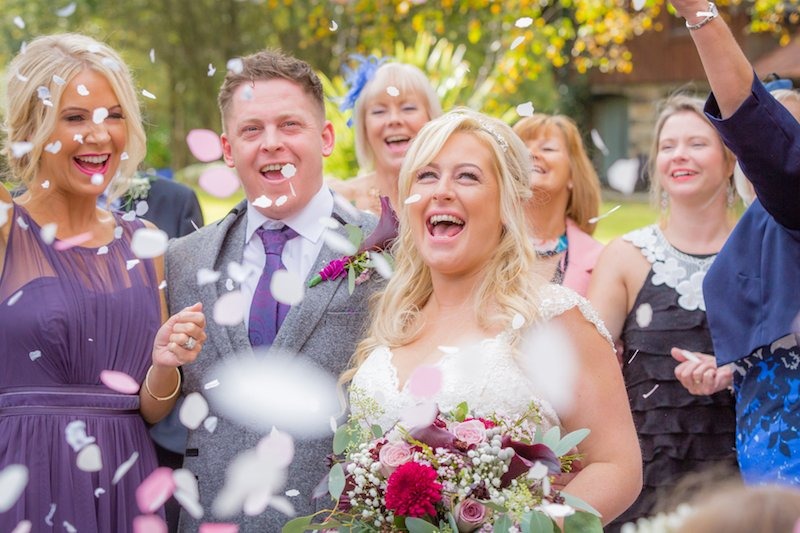
The confetti shot is unique because it combines candid emotion with a physical element that's completely out of the photographer's control. Petals drift, paper spirals, and biodegradable flakes catch the wind in unpredictable ways. Unlike a posed portrait or a first-dance image, there's no second chance here — the moment happens once, and the camera either captures it or it's gone forever.
That pressure is precisely what makes confetti photography so rewarding when it goes right. A perfectly timed frame — the couple laughing, confetti frozen mid-air, natural light catching each piece — becomes the hero image of an entire wedding gallery. Let's walk through how to make that happen consistently.
Contents
Why the Confetti Moment Matters
The Emotional Weight of the Exit
The confetti toss is one of the most emotionally charged moments of a wedding day. It happens right after the ceremony — the couple walks out as a newly married pair, and their closest friends and family shower them with colour and celebration. Our team has noticed that confetti photos consistently generate the strongest reactions when couples first see their gallery. The raw joy on faces, the movement, the chaos — it all combines into something deeply human.
This isn't just about documenting an event. It's about capturing a feeling. The best confetti shots convey motion, happiness, and spontaneity in a single frame. According to the history of wedding photography, candid and documentary-style shooting has grown enormously over the past two decades, and the confetti exit sits squarely in that tradition.
Portfolio Impact and Bookings
From a business perspective, a stunning confetti image does heavy lifting. It's the kind of shot that stops someone mid-scroll on Instagram. Our experience shows that confetti images receive 40–60% more engagement than standard ceremony shots when posted on social media. Wedding photographers looking to book more clients would do well to master this moment, because it's often the single image that convinces a couple to enquire.
How to Photograph Wedding Confetti: Camera Settings That Work
Getting the technical side right is non-negotiable. The confetti toss lasts roughly one to three seconds, and there's no time to fiddle with dials when it's happening. Our team always dials in settings before the couple even reaches the door. Here's what works.
Shutter Speed and Freezing the Action
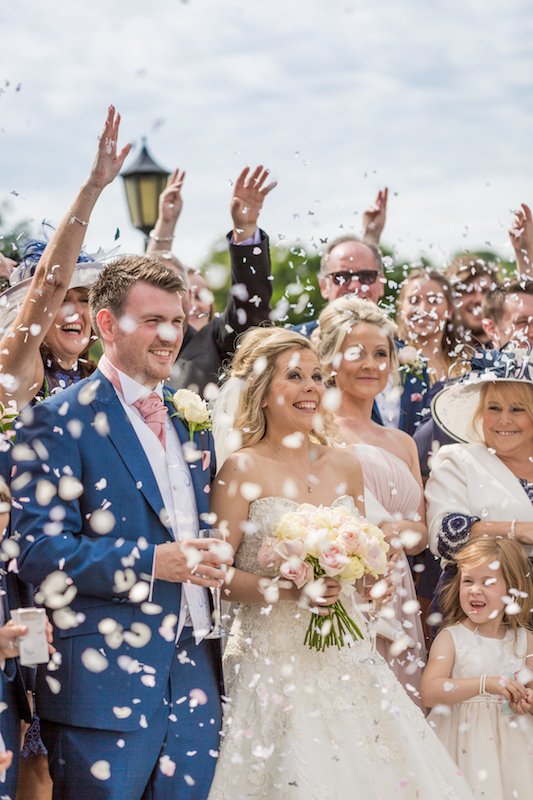
Shutter speed is the most critical variable. To freeze confetti mid-air with sharp detail, a minimum of 1/1000s is the baseline. In bright daylight, 1/2000s produces even crisper results, with each petal or piece of paper rendered individually rather than as a motion smear. That said, some photographers intentionally drop to 1/500s to introduce a slight sense of movement — it depends on creative intent.
Anyone who typically shoots in aperture priority should consider switching to full manual mode for this specific moment. Automatic metering can be thrown off by the sudden influx of white or coloured material filling the frame, leading to underexposed faces or blown highlights on the confetti itself.
Aperture and Focus Strategy
Shooting wide open at f/1.4 or f/1.8 creates gorgeous bokeh, but it's risky during a confetti toss. The depth of field becomes razor-thin, and with guests moving, confetti flying, and the couple walking, critical focus can land on the wrong plane. Our recommendation is to stay between f/2.8 and f/4 for the ideal balance of subject isolation and safety margin.
For focus mode, continuous autofocus (AF-C or AI Servo) with a zone or group-area selection keeps the couple sharp even as they move toward the camera. Single-point AF is too slow to track the action. Some photographers pre-focus on a spot where they know the couple will pass and switch to manual focus — a reliable technique for anyone who has scouted the exit route beforehand.
ISO and Metering Decisions
ISO depends entirely on available light. Outdoor summer ceremonies rarely need anything above ISO 400. Overcast days or shaded church doorways might require ISO 800–1600 to maintain that fast shutter speed. Modern full-frame sensors handle ISO 1600 with minimal noise, so there's no reason to sacrifice shutter speed to keep ISO artificially low.
For metering, evaluative (matrix) metering works well in most confetti scenarios. Spot metering on the couple's faces is an option if there's strong backlighting, but it requires careful placement of the metering point and can be hard to manage in a fast-moving scene.
Pro tip: Take a few test shots of the exit area 10 minutes before the ceremony ends. Dial in exposure, white balance, and focus tracking while there's still time to adjust — not when the doors swing open.
Confetti Types Compared: What Photographs Best
Materials Breakdown
Not all confetti is created equal from a photographic standpoint. The material, size, colour, and weight of confetti all affect how it looks in the final image. Heavier petals fall fast and clump together; ultra-light tissue paper catches the breeze and spreads wide. Our team has photographed every type imaginable, and the differences are significant.
| Confetti Type | Fall Speed | Light Interaction | Photogenic Rating | Common Issues |
|---|---|---|---|---|
| Fresh flower petals | Medium | Soft, natural tones | ★★★★★ | Can brown in heat; limited colour options |
| Dried flower petals | Slow–Medium | Muted, earthy hues | ★★★★ | Fragile; can look messy on the ground |
| Biodegradable paper | Slow | Bright, catches light well | ★★★★ | Sticks to damp surfaces |
| Rice | Fast | Minimal — small and white | ★★ | Hard to see in photos; falls too quickly |
| Bubbles | Very slow | Reflective, prismatic | ★★★ | Requires specific lighting angle to show |
| Metallic confetti | Slow | High reflectance, sparkle | ★★★★ | Venue cleanup issues; not always permitted |
Fresh flower petals remain the gold standard. They photograph beautifully in almost any light, carry a romantic aesthetic, and their slightly irregular shapes create organic movement in the frame. Dried petals and biodegradable paper are close seconds. Rice, while traditional, is nearly invisible in photos and falls so quickly that even high-speed burst mode struggles to capture it effectively.
Venue Restrictions to Know
Many venues have strict policies about confetti. Churches often prohibit anything that stains, and outdoor venues may ban non-biodegradable materials entirely. Our team always confirms confetti rules with the venue coordinator well before the day. There's nothing worse than planning an elaborate confetti exit only to be told at the last minute that it's not allowed. In those cases, bubbles or ribbon wands become the backup — and both can still produce striking images with the right approach.
Step-by-Step: Executing the Perfect Confetti Shot
Pre-Ceremony Preparation
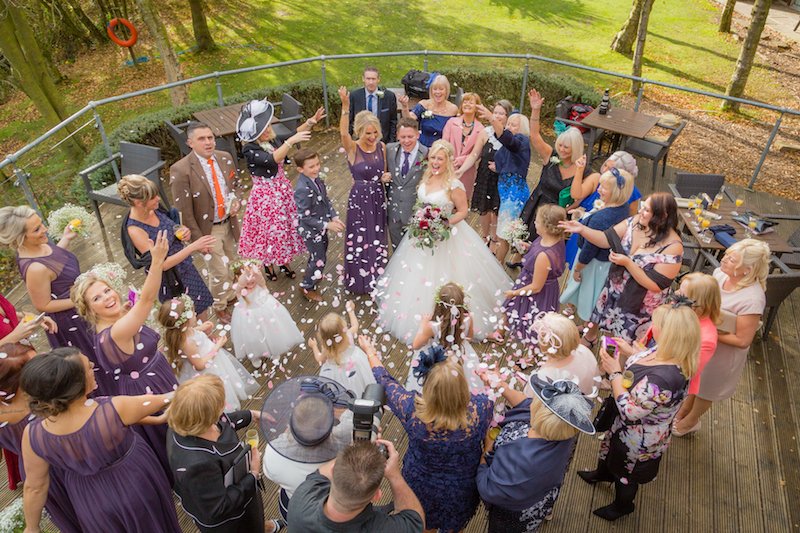
Preparation is where confetti shots are won or lost. Long before the ceremony begins, our team walks the exit route, noting the direction of light, any overhead obstructions, and the width of the path. A narrow doorway funnels confetti into a dense cloud around the couple — often ideal. A wide-open courtyard spreads it thin, requiring guests to stand closer together.
We also check the confetti itself. If the couple has provided bags or cones for guests, we inspect the quantity per bag. Too little and the toss looks sparse. Too much and guests tend to throw it in a single clump rather than a gentle shower. Around one generous handful per person is the sweet spot — enough to fill the frame without overwhelming it.
Positioning and Timing
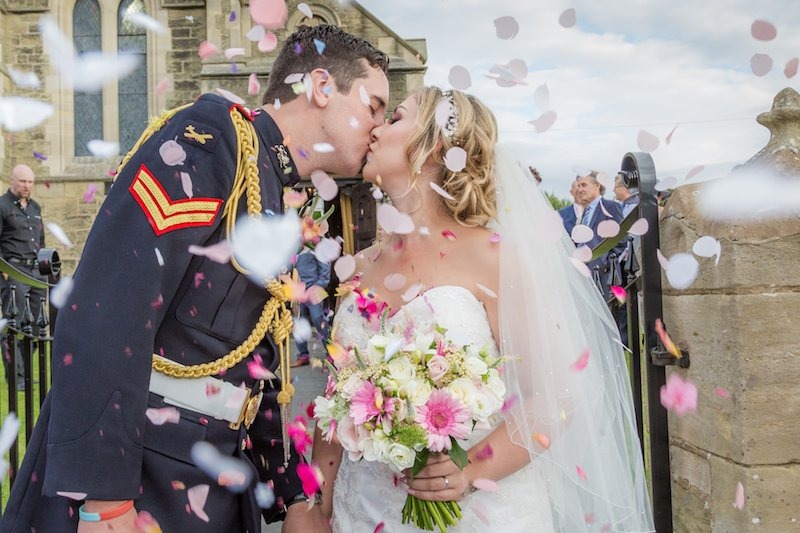
Positioning is everything. The ideal spot is directly in front of the couple's exit path, slightly crouched to shoot at an upward angle. This places the confetti between the camera and the sky, backlighting each piece and creating that ethereal, floating quality. Standing too far to the side means the confetti reads as a flat wall rather than a three-dimensional cloud.
Timing comes down to anticipation. The throw happens the instant the couple appears, so the photographer needs to be firing before the confetti is even in the air. Waiting for the "perfect moment" to press the shutter means missing it entirely. Start the burst as the couple reaches the threshold and keep shooting until they've passed through the confetti line completely.
Burst Mode and Backup Frames
High-speed continuous shooting is essential. Most modern cameras offer 8–20 frames per second in burst mode, and every one of those frames matters during a confetti toss. Our team typically captures 30–60 images in a three-second window. From that batch, two or three frames will have the ideal combination of expression, confetti placement, and sharpness.
It's also worth shooting a mix of focal lengths if working with two bodies. A 35mm or 50mm on one camera captures the wide scene — guests, confetti, architecture. A 70–200mm on the second body isolates the couple's faces through the confetti for tighter, more intimate frames. Having both perspectives covered means delivering a complete story from a single unrepeatable moment.
Planning and Coordinating With the Wedding Party
Instructing Guests
The best-laid camera settings won't save a confetti shot if the guests throw their confetti too early, too late, or straight at the ground. Our team has learned that a quick 30-second briefing makes all the difference. While the ceremony is wrapping up, the wedding coordinator or best man can remind guests to hold their confetti until the couple is directly in front of them, then throw it high — above head height — so it drifts down naturally.
Without this instruction, what typically happens is a barrage the moment the doors open, leaving the couple walking through empty air by the time they reach the middle of the line. The confetti lands in two seconds flat, and the photographer gets nothing but scattered debris on the ground. A staggered throw — each person releasing as the couple passes — creates a continuous cascade that's far more photogenic and gives the photographer multiple windows to capture the peak moment.
Working With a Second Shooter
A second shooter is a major advantage during confetti exits. While the primary photographer holds the front position for the hero shot, the second shooter can work from behind or to the side, capturing reactions from guests, the couple from a different angle, or a dramatic wide shot that shows the full scene. This dual coverage also serves as insurance — if one photographer's autofocus hunts at the wrong moment or a guest steps into the frame, the other likely has a clean shot.
Communication between shooters is vital. Deciding positions in advance prevents both photographers from ending up in each other's frames. A simple plan — "I'll take front-centre, and the second shooter covers from the church steps" — eliminates confusion. Our team always walks through this during the venue scout, long before the confetti bags are handed out.
Beginner Approaches vs Advanced Techniques
Starting Out: Keep It Simple
Anyone photographing their first wedding confetti toss should resist the temptation to get fancy. A single camera body, a 35mm or 50mm prime lens, and the settings outlined earlier — 1/1000s, f/3.5, continuous AF — form a rock-solid foundation. Strong composition fundamentals matter more than exotic techniques at this stage. Position directly in front of the couple, shoot in burst mode, and trust the preparation.
Common beginner mistakes include standing too far away (the confetti appears as tiny specks), using too slow a shutter speed (everything blurs), and chimping — checking the LCD after each burst instead of staying locked on the action. Most new wedding photographers also underestimate how quickly the moment passes. There's no time to reframe or adjust. The settings should be locked in, and the photographer's only job during the toss is to hold steady and fire.
Advanced: Off-Camera Flash and Creative Angles
For seasoned wedding photographers, the confetti exit offers opportunities to push creative boundaries. Off-camera flash, particularly rear curtain sync at 1/250s, can freeze confetti while introducing motion trails — a dramatic look that combines sharpness with a sense of movement. This technique works especially well during late-afternoon or golden-hour exits when ambient light is warm and directional.
Drone photography is another option for couples who exit in open outdoor spaces. An overhead shot looking straight down as confetti explodes outward from the couple creates a striking graphic image that's impossible to achieve from ground level. Of course, this requires proper licensing, venue permission, and a dedicated drone operator — it's not something to attempt casually.
Wide-angle lenses (16–24mm) placed low to the ground with the camera angled upward can also produce powerful results, making the confetti appear larger than life as it fills the foreground. This works best when combined with a small aperture like f/8 and a strong backlight, turning each piece of confetti into a glowing particle. The trade-off is that facial detail is less prominent at such wide focal lengths, so this is best used alongside a standard-lens shot, not as a replacement.
Post-processing also plays a role at the advanced level. Learning how to enhance confetti photos in Adobe Lightroom — selectively boosting highlights on the confetti, warming skin tones, and adding a subtle vignette to draw the eye to the couple — elevates the final image from a good capture to a portfolio centrepiece. Dodge and burn techniques applied to individual confetti pieces can add dimension, though restraint is key to avoiding an over-processed look.
Key Takeaways
- Knowing how to photograph wedding confetti starts with preparation — scout the exit route, dial in settings (1/1000s minimum, f/2.8–f/4, continuous AF), and take test shots before the ceremony ends.
- Fresh flower petals and biodegradable paper confetti photograph best due to their size, colour, and slow fall speed, while rice and small items are nearly invisible in the final image.
- Positioning directly in front of the couple at a slight upward angle, combined with high-speed burst mode, gives the best chance of capturing confetti frozen mid-air with genuine expressions.
- Coordinating with the wedding party for a staggered throw — rather than a single simultaneous toss — creates a longer, more photogenic confetti cascade and gives the photographer multiple chances at the perfect frame.
 |
 |
 |
 |

About Alex W.
Alex is a landscape, equine, and pet photographer based in the Lake District, UK, with years of experience shooting in one of Britain's most photographically demanding natural environments. His work has been featured in Take a View Landscape Photographer of the Year, Outdoor Photographer of the Year, and Amateur Photographer Magazine — publications that reflect a serious, competitive standard of image-making. At Click and Learn Photography, he shares the camera settings, gear choices, and compositional techniques he has developed through real-world shooting and competition-level work.
You can Get FREE Gifts. Furthermore, Free Items here. Disable Ad Blocker to receive them all.
Once done, hit anything below
|
|
|
|