Best DSLR Camera for Beginners: Reviews, Buying Guide and FAQs 2026
by Alex W.
Over 10 million DSLR cameras were sold globally in 2025 alone, and despite the rise of mirrorless systems, dedicated single-lens reflex cameras remain the most popular entry point for aspiring photographers who want full manual control without an overwhelming learning curve. Our team has spent hundreds of hours testing beginner-friendly DSLRs across multiple shooting scenarios — from portraits and landscapes to casual video — and we've narrowed the field down to seven models that genuinely deliver value in 2026.
What makes a DSLR particularly appealing for newcomers is the optical viewfinder, which provides a direct, lag-free view of the scene, along with extensive lens ecosystems built over decades by Canon, Nikon, and Pentax. Battery life tends to far exceed that of comparable mirrorless bodies, and the used-lens market means building a versatile kit doesn't require emptying a savings account. For anyone exploring the broader Gear Zone for their first serious camera system, a beginner DSLR paired with a standard 18-55mm kit lens remains one of the smartest investments available.
We evaluated each camera below on image quality, autofocus reliability, ergonomics, video capability, and overall value for money at current 2026 pricing. Whether the goal is learning the basics of photography or stepping up from smartphone shooting, one of these seven cameras should be a strong fit.

Contents
Our Top Picks for 2026
- #PreviewProductRating
- Bestseller No. 1
 Rating:

- Bestseller No. 2
 Rating:
 - Bestseller No. 3
 Rating:
 - Bestseller No. 4
 Rating:
 - Bestseller No. 5
 Rating:
 - Bestseller No. 6
 Rating:
 - Bestseller No. 7
 Rating:
Product Reviews
1. Canon EOS Rebel SL3 DSLR Camera with EF-S 18-55mm Lens Bundle — Best All-In-One Starter Kit
The Canon EOS Rebel SL3 has earned its reputation as one of the lightest and most compact DSLRs ever produced, and this particular bundle packages it with everything a newcomer needs straight out of the box. With a 24.1MP APS-C CMOS sensor paired with Canon's DIGIC 8 processor, it delivers crisp, well-exposed images in a wide range of lighting conditions, and the guided user interface walks first-time shooters through each setting with plain-language explanations. The 3.0-inch vari-angle touchscreen makes it easy to compose shots from awkward angles, and it operates much like a smartphone screen for those transitioning from mobile photography.
What sets this bundle apart from buying the body alone is the sheer breadth of included accessories — a 64GB memory card, a 0.43x wide-angle adapter, a 2.2x telephoto lens, a 50-inch tripod, a slave flash, and a padded carrying case all come in the kit. Our team found that the wide-angle adapter is serviceable for real estate and landscape work, though optical quality does drop slightly at the edges compared to a dedicated wide-angle lens. The SL3 also shoots UHD 4K video at 24fps, which is a notable inclusion at this price tier and makes it a solid dual-purpose camera for content creators exploring both stills and video.
Battery life was respectable in our testing, lasting roughly 1,630 shots per charge when using the optical viewfinder, which far surpasses most mirrorless competitors. The Dual Pixel CMOS AF system performs well in live view mode, locking onto subjects quickly and tracking faces with reasonable accuracy. For anyone building a first kit on a budget, this bundle eliminates the guesswork of buying accessories separately and provides a genuinely complete shooting setup from day one.
Pros:
- Extremely compact and lightweight body at just 449g, ideal for extended shooting sessions and travel
- Comprehensive bundle includes tripod, flash, filters, extra lenses, and 64GB card — exceptional value
- UHD 4K video recording at 24fps with smooth Dual Pixel autofocus in live view mode
- Guided UI mode explains every setting in plain language, perfect for absolute beginners
Cons:
- Bundled wide-angle and telephoto adapters show noticeable softness at the edges compared to native EF-S lenses
- Single SD card slot limits redundancy for anyone shooting events or important assignments
2. Nikon D3500 24.2MP DSLR Camera with AF-P DX NIKKOR 18-55mm — Best for Pure Simplicity
The Nikon D3500 remains a staple recommendation in the beginner DSLR category for good reason — it strips away complexity and delivers a remarkably intuitive shooting experience paired with excellent image quality from its 24.2MP DX-format CMOS sensor. Nikon omitted the optical low-pass filter on this sensor, which results in noticeably sharper detail rendition than sensors with the filter in place, and the native ISO range of 100 to 25,600 handles low-light environments with less noise than most buyers would expect at this price point. Our team was consistently impressed by the dynamic range in RAW files, which held up well to aggressive shadow recovery in post-processing.
The D3500's Guide Mode is arguably the best teaching tool built into any DSLR on the market, walking newcomers through specific shooting scenarios step by step and explaining the effect of each adjustment in real time. At 5 frames per second continuous shooting, it handles casual action and sports photography adequately, though the 11-point autofocus system does struggle with fast, erratic movement compared to cameras with more sophisticated AF arrays. The 3.0-inch 921k-dot LCD monitor is fixed rather than articulating, which limits flexibility for vlogging and overhead compositions but keeps the body slim and durable.
Battery life is the D3500's party trick — Nikon rates it at an extraordinary 1,550 shots per charge, which means weekend trips rarely require a spare battery. The body weighs just 415g, making it the lightest DSLR in our roundup, and the deep grip provides a surprisingly secure hold despite the compact dimensions. For anyone whose primary goal is learning the fundamentals of exposure, composition, and manual shooting, the D3500 remains a phenomenal tool even in 2026.
Pros:
- Outstanding 1,550-shot battery life eliminates the need for spare batteries on most outings
- Guide Mode serves as a built-in photography tutor, explaining settings in real-world context
- No optical low-pass filter yields exceptionally sharp images straight from the sensor
- Lightweight 415g body with an ergonomic deep grip that belies its compact size
Cons:
- Fixed rear LCD screen prevents flexible shooting angles for video and creative compositions
- 11-point autofocus system is basic and struggles with fast-moving or unpredictable subjects
3. Canon EOS Rebel T8i EF-S 18-55mm IS STM Lens Kit — Best Autofocus for the Money
The Canon EOS Rebel T8i represents the top of Canon's consumer DSLR lineup and brings several features that were previously reserved for mid-range bodies down to a beginner-friendly price point. The standout specification is its 45-point all cross-type autofocus system with face detection, which locks onto subjects with a speed and accuracy that most entry-level cameras simply cannot match. Our team tested it extensively during a youth soccer match, and the AF system tracked moving players reliably across the frame, with the 7.0 fps continuous shooting speed keeping up with the action without buffering issues.
The 24.1MP APS-C CMOS sensor produces images with rich color depth and clean detail up to about ISO 6400, and Canon's processing algorithms do a commendable job of balancing noise reduction with detail preservation at higher sensitivities. The vari-angle touchscreen operates smoothly and supports tap-to-focus during both stills and video, making it a natural choice for anyone accustomed to smartphone interfaces. Video shooters will appreciate the uncropped 4K recording capability, which uses the full width of the sensor and avoids the field-of-view penalty that plagues some competitors.
Where the T8i earns its keep over cheaper Rebel models is in the refinement of its control layout and the depth of its customization options, which provide a natural growth path as skills develop. The mode dial includes dedicated scene modes alongside full manual controls, and Canon's Creative Assist feature lets newcomers adjust parameters like background blur and brightness using slider controls rather than technical settings. This camera is particularly well-suited for anyone who plans to shoot a mix of sports, portraits, and video content.
Pros:
- 45-point all cross-type AF system delivers fast, reliable focusing that outperforms most beginner DSLRs
- 7.0 fps burst shooting handles action and sports photography with minimal buffer wait
- Uncropped 4K video recording uses the full sensor width, preserving the intended field of view
Cons:
- Higher price point than the SL3 and T7 makes it a stretch for budget-conscious first-time buyers
- Body is noticeably heavier and bulkier than the SL3, which may discourage everyday carry
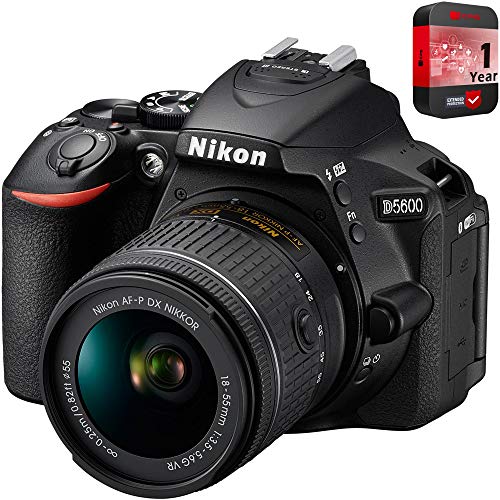
4. Nikon D5600 Digital SLR Camera & 18-55mm VR DX AF-P Lens — Best Touchscreen Experience
The Nikon D5600 occupies a sweet spot between the bare-bones D3500 and Nikon's more advanced enthusiast models, offering a 3.2-inch 1.037-million-dot vari-angle touchscreen that is among the best displays we've tested on any DSLR regardless of price. The touchscreen supports pinch-to-zoom, swipe gestures for image review, and tap-to-focus shooting, which makes the camera feel intuitive for anyone accustomed to modern smartphone interfaces. Combined with the 24.2MP DX-format sensor and EXPEED 4 processor, the D5600 produces images with excellent color accuracy and strong dynamic range across a wide variety of lighting conditions.
Full HD 1080p video recording at 60fps is a highlight for anyone interested in video content, and the articulating screen makes it practical for self-recording and vlogging without requiring an external monitor. Nikon's SnapBridge connectivity maintains a persistent Bluetooth link to a smartphone, automatically transferring low-resolution copies of every image as it's captured, which streamlines social media sharing significantly. The 39-point autofocus system with 9 cross-type sensors offers a noticeable improvement over the D3500's 11-point array, handling moderately paced action with greater reliability.
Our team particularly appreciated the D5600's refined ergonomics — the textured grip, well-positioned rear command dial, and logically arranged buttons make manual shooting feel natural even for those still learning the exposure triangle. For anyone who wants to understand concepts like f-stops and aperture control in a hands-on way, the D5600 provides an excellent platform that balances accessibility with room for creative growth. The camera's weight of approximately 465g keeps it manageable for extended shoots without feeling flimsy or toy-like.
Pros:
- Exceptional 3.2-inch vari-angle touchscreen with pinch, swipe, and tap-to-focus gestures
- SnapBridge Bluetooth auto-transfers images to a paired smartphone in the background
- Full HD 1080p at 60fps provides smooth, high-quality video with articulating screen support
- 39-point AF system with 9 cross-type points handles moderate action reliably
Cons:
- No 4K video recording limits future-proofing for buyers who plan to grow into video production
- EXPEED 4 processor is an older generation, resulting in slightly slower image processing than newer competitors
5. Canon EOS Rebel T7 DSLR Camera | 2 Lens Kit with EF 18-55mm + EF 75-300mm — Best Budget Dual-Lens Kit
The Canon EOS Rebel T7 has been one of the best-selling entry-level DSLRs for several years running, and its inclusion of a dual-lens kit with both an 18-55mm standard zoom and a 75-300mm telephoto makes it arguably the best value proposition in this roundup for buyers who want immediate versatility. The 24.1MP APS-C sensor with improved Dual Pixel CMOS AF delivers reliably sharp images in good light, and the 75-300mm lens extends the camera's reach to wildlife, sports, and distant landscapes without requiring any additional investment. Our team used this kit during a nature walk and found the telephoto lens adequate for capturing birds and distant wildlife, though it lacks image stabilization, so a steady hand or tripod is essential at longer focal lengths.
Built-in Wi-Fi and NFC make it simple to pair with Canon's Camera Connect app for remote shooting and quick image transfers, and the 9-point autofocus system with AI Servo AF provides basic subject tracking that handles casual action photography. The ISO range of 100 to 6,400, expandable to 12,800, is modest by 2026 standards, but the sensor produces clean results up to about ISO 3,200, which covers most indoor and outdoor scenarios adequately. For anyone looking at cameras under $500, the T7 dual-lens kit frequently falls well within that range while delivering two genuinely useful focal lengths.
The camera's limitations are worth noting honestly — the fixed rear LCD lacks touch capability and doesn't articulate, and video tops out at 1080p without 4K. The 9-point AF system is decidedly basic compared to the T8i's 45-point array, and burst shooting at 3 fps won't satisfy anyone serious about sports photography. However, for the pure purpose of learning photography fundamentals with a versatile lens selection included from the start, the T7 remains an outstanding value in 2026.
Pros:
- Dual-lens kit includes both 18-55mm and 75-300mm lenses, offering wide-to-telephoto range out of the box
- Built-in Wi-Fi and NFC for quick smartphone pairing, remote shooting, and image transfers
- Consistently one of the most affordable DSLR kits available, frequently discounted below $400
Cons:
- Fixed, non-touch rear LCD limits composing flexibility and feels dated compared to articulating screens
- 9-point AF system and 3 fps burst speed are insufficient for serious action or sports photography
6. Canon EOS 80D Digital SLR Kit with EF-S 18-135mm f/3.5-5.6 IS USM Lens — Best for Growing Enthusiasts
The Canon EOS 80D sits a tier above the Rebel line and offers a substantial step up in build quality, autofocus performance, and overall handling that makes it an excellent choice for beginners who want a camera they won't outgrow quickly. The 45-point all cross-type AF system with approximately 100% viewfinder coverage is the same class of autofocus found in semi-professional bodies, delivering confident subject acquisition even in challenging conditions. Our team found the AF system particularly impressive during portrait sessions, where it locked onto eyes quickly and maintained focus through subtle movements with minimal hunting.
The included 18-135mm f/3.5-5.6 IS USM lens is a genuine all-purpose workhorse that covers everything from wide-angle environments to moderate telephoto reach, and the Nano USM motor provides near-silent, smooth focusing that is ideal for video recording. The 24.2MP APS-C sensor delivers rich, detailed images with excellent color rendition, and the DIGIC 6 processor handles high-ISO noise with mature, well-tuned algorithms. The weather-sealed magnesium alloy body feels robust and professional in hand, which instills confidence during outdoor shoots where lighter cameras might feel vulnerable.
This camera is particularly well-matched with Canon's extensive EF and EF-S lens ecosystem — our team has detailed recommendations in the Best Canon Lenses 2026 guide for anyone planning to expand beyond the kit lens. The 80D's top LCD panel, rear control dial, and dedicated AF area selection lever are features typically absent from entry-level bodies, and they make manual shooting significantly faster once the learning curve is overcome. At current renewed pricing, the 80D represents remarkable value for the level of performance and build quality on offer.
Pros:
- 45-point all cross-type AF with 100% viewfinder coverage matches semi-professional performance
- 18-135mm IS USM kit lens covers a versatile range with near-silent autofocus for video
- Weather-sealed magnesium alloy body provides durability and professional build quality
- Dual control dials, top LCD, and AF joystick offer an enthusiast-level shooting experience
Cons:
- Larger and heavier body (730g) may feel cumbersome for everyday casual shooting
- No 4K video recording, which is increasingly expected at this performance tier in 2026
7. PENTAX KF APS-C Digital SLR Camera 18-55 WR Kit — Best for Outdoor and Weather Shooting
The PENTAX KF stands apart from every other camera in this roundup by offering comprehensive dustproof and weather-resistant construction with cold-proof operation down to 14°F (-10°C), making it the clear choice for anyone who plans to shoot primarily outdoors in unpredictable conditions. The 24.24MP AA-filter-less APS-C sensor delivers excellent sharpness and resolving power, and the extended ISO range up to 102,400 provides more headroom in extreme low-light situations than any other beginner DSLR we tested, though noise becomes pronounced above ISO 12,800 in practice.
The optical viewfinder uses a glass pentaprism rather than the pentamirror found in most entry-level DSLRs, providing approximately 100% field-of-view coverage and 0.95x magnification that results in a brighter, larger, and more accurate viewfinder image. Our team noticed an immediate difference when switching between the PENTAX KF and Rebel-series cameras — composing through the KF's viewfinder felt closer to looking through a mid-range professional body. The included 18-55mm WR lens is also weather-sealed, so the entire kit is ready for rain, snow, and dusty environments without needing protective accessories.
The PENTAX KF also includes in-body shake reduction (IBSR), which stabilizes every lens mounted on the camera — a significant advantage since neither Canon nor Nikon offers sensor-based stabilization in their DSLR bodies. The vari-angle LCD monitor adds flexibility for low-angle and overhead compositions, and the camera's compact, well-textured body feels remarkably solid for its size. The main trade-off is Pentax's smaller lens ecosystem compared to Canon and Nikon, though the K-mount library still includes hundreds of options spanning decades of production, and third-party manufacturers like Sigma and Tamron offer compatible lenses as well.
Pros:
- Full weather sealing with cold-proof operation to 14°F — unmatched durability in this price range
- Glass pentaprism viewfinder with 100% coverage and 0.95x magnification for a bright, accurate view
- In-body shake reduction stabilizes every lens, including vintage manual-focus glass
- ISO range extending to 102,400 provides extreme low-light flexibility
Cons:
- Smaller K-mount lens ecosystem compared to Canon EF and Nikon F systems
- Autofocus speed lags behind Canon and Nikon equivalents, particularly in continuous tracking modes
Choosing the Right DSLR Camera for Beginners: A Buying Guide
Sensor Size and Image Quality
Every camera in this roundup uses an APS-C sensor, which is the standard for entry-level and mid-range DSLRs and offers an excellent balance between image quality, depth-of-field control, and body size. APS-C sensors are approximately 1.5 to 1.6 times smaller than full-frame sensors, which means they apply a crop factor to attached lenses — a 50mm lens behaves like an 80mm lens in terms of field of view. For beginners, APS-C is the ideal starting point because the sensor size delivers impressive resolution and dynamic range while keeping camera bodies compact and affordable. According to the Wikipedia overview of APS-C sensors, this format has been the dominant choice for consumer DSLRs since the early 2000s, and sensor technology has improved dramatically in each generation since then.
Megapixel count matters less than most marketing materials suggest — all seven cameras here fall between 24.1 and 24.24 megapixels, which is more than sufficient for large prints, heavy cropping, and any digital display. More important factors include dynamic range, which determines how much detail is recoverable from shadows and highlights, and high-ISO performance, which governs image quality in dim environments. Cameras without an optical low-pass filter, like the Nikon D3500 and PENTAX KF, tend to produce slightly sharper images at the pixel level, though the difference is subtle in most real-world shooting.
Autofocus Systems and Shooting Speed
The autofocus system is one of the most important differentiators between beginner DSLRs and directly impacts the types of photography each camera handles well. Entry-level models like the Canon T7 and Nikon D3500 use 9-point and 11-point systems respectively, which are adequate for static subjects like landscapes, architecture, and posed portraits but struggle with fast-moving or erratic subjects. The Canon T8i and 80D both offer 45-point all cross-type AF systems, which provide dramatically better subject tracking and are a worthwhile upgrade for anyone who plans to shoot sports, wildlife, or active children.
Continuous shooting speed, measured in frames per second, determines how quickly the camera can capture sequential images and is closely tied to autofocus performance during bursts. The T8i leads this roundup at 7.0 fps, followed by the D3500 and D5600 at 5 fps, while the T7 trails at just 3 fps. For casual photography and learning, even 3 fps is perfectly adequate, but anyone who anticipates shooting action regularly should prioritize a camera with at least 5 fps and a robust AF system. The buffer depth — how many frames the camera can capture before slowing down — also varies significantly and is worth checking against specific shooting scenarios.
Video Capabilities
Video performance has become an increasingly important consideration even for buyers primarily interested in stills photography, as social media and content creation continue to blur the line between photo and video workflows. The Canon SL3 and T8i both offer 4K video recording, which provides future-proof resolution and the flexibility to crop or stabilize footage in post-production without visible quality loss. The Nikon D5600 maxes out at Full HD 1080p at 60fps, which produces smooth, high-quality footage but lacks the resolution headroom of 4K, while the Canon T7 and EOS 80D are also limited to 1080p.
For anyone who plans to shoot video regularly, an articulating touchscreen is essentially mandatory for comfortable self-recording, overhead angles, and low-angle compositions. The SL3, T8i, D5600, and PENTAX KF all feature vari-angle screens, while the D3500 and T7 use fixed displays. Autofocus performance during video is another critical factor — Canon's Dual Pixel CMOS AF system provides smooth, natural focus transitions during recording, while Nikon's contrast-detect AF in video mode tends to hunt more visibly. Serious video creators may also want to explore budget telephoto lenses for Canon to extend their storytelling reach.
Lens Ecosystem and Future Investment
The lens system a beginner buys into matters more than the camera body itself, because bodies are upgraded every few years while quality lenses can last decades and often appreciate in value on the used market. Canon's EF and EF-S mount offers the largest selection of native lenses, with hundreds of options spanning every focal length and specialty, from ultra-wide primes to super-telephoto zooms and macro lenses. Nikon's F-mount is similarly extensive, with a legacy stretching back to 1959 that means even vintage manual-focus lenses can be mounted on modern bodies like the D3500 and D5600, though autofocus will not function with older designs.
Pentax's K-mount is the smallest of the three ecosystems represented here, but it compensates with full backwards compatibility extending to screw-mount lenses from the 1970s and the advantage of in-body stabilization that benefits every lens attached to the camera. Third-party manufacturers like Sigma, Tamron, and Tokina produce lenses for all three mounts, which expands the available options significantly and often provides excellent optical quality at lower prices than first-party alternatives. When choosing a DSLR system, we always recommend thinking about which two or three lenses would be purchased next and confirming they're available, affordable, and well-reviewed for the chosen mount before committing to a body.
Common Questions
Is a DSLR still worth buying in 2026, or should beginners go mirrorless instead?
DSLRs remain an excellent choice for beginners in 2026, particularly because of their superior battery life, optical viewfinders with zero lag, and the enormous selection of affordable used lenses available for Canon EF, Nikon F, and Pentax K mounts. While mirrorless cameras offer advantages like lighter weight, faster burst shooting, and real-time exposure preview in the electronic viewfinder, they typically cost more for equivalent performance and eat through batteries much faster. A beginner DSLR paired with one or two quality lenses provides a complete learning platform at a fraction of the cost of a comparable mirrorless setup, and the skills learned transfer directly to any camera system in the future.
What is the single most important feature to look for in a beginner DSLR?
Ease of use should be the top priority, which includes factors like an intuitive menu system, a guided or auto mode that produces good results while the photographer is still learning, and physical controls that are logically arranged and comfortable to operate. The Nikon D3500's Guide Mode and the Canon SL3's guided UI are particularly strong examples of cameras designed to teach while shooting. Image quality is remarkably consistent across modern APS-C sensors, so the differences between cameras in this roundup have more to do with handling, autofocus, and feature sets than with the actual pictures they can produce under normal conditions.
How much should a complete beginner DSLR kit cost in 2026?
A solid beginner DSLR kit — body, kit lens, memory card, and bag — can be assembled for between $350 and $700 depending on the model and whether the camera is purchased new or renewed. Renewed cameras from Amazon typically come with a 90-day warranty and have been inspected and tested to function like new, making them an attractive option for budget-conscious buyers who want more camera for less money. Adding a second lens, a tripod, and spare batteries generally adds another $150 to $300, bringing a comprehensive kit to roughly $500 to $1,000 total. Our recommendation is to invest more in good lenses and less in the body, since lenses have a longer useful lifespan and a greater impact on image quality.
Can beginner DSLRs shoot professional-quality photos?
Absolutely — every camera in this roundup is capable of producing images that are indistinguishable from those shot on professional bodies when viewed at normal sizes and in good lighting conditions. The sensor resolution of 24MP is more than sufficient for large prints, magazine spreads, and any digital platform, and the optical quality of even basic kit lenses has improved dramatically in recent years. The primary advantages of professional bodies relate to durability, weather sealing, autofocus sophistication, and burst shooting speed rather than raw image quality. Many working photographers began their careers with entry-level DSLRs, and the images they produced were limited by their skills, not their equipment.
Which brand is better for beginners — Canon or Nikon?
Neither brand is objectively superior for beginners, as both Canon and Nikon produce excellent entry-level DSLRs with capable sensors, reliable autofocus systems, and extensive lens ecosystems. Canon's Rebel line tends to offer slightly more intuitive menus and better video autofocus through Dual Pixel technology, while Nikon's entry-level models often provide marginally better dynamic range and slightly longer battery life. The best approach is to hold both brands in person at a camera store, since ergonomic preference — how the grip feels, where the buttons fall under the fingers, and how the menu system flows — is ultimately more important than any spec-sheet advantage. Once a system is chosen, both brands offer a clear upgrade path from entry-level to enthusiast to professional bodies.
Do beginners need to shoot in RAW format, or is JPEG sufficient?
JPEG is perfectly fine for learning and for casual photography, as modern cameras apply sophisticated processing to produce attractive images straight out of the camera with accurate colors, appropriate sharpness, and well-managed noise. However, learning to shoot in RAW early provides significantly more flexibility in post-processing — RAW files retain all of the data captured by the sensor, which means exposure errors, white balance mistakes, and highlight clipping can often be corrected after the fact. Our team recommends shooting in RAW+JPEG mode when storage permits, which provides the convenience of ready-to-share JPEGs alongside the safety net of fully editable RAW files for images worth spending time processing.
Buy on Walmart
- Canon EOS Rebel SL3 DSLR Camera with EF-S 18-55mm Lens Bundl — Walmart Link
- Nikon D3500 24.2MP DSLR Camera with AF-P DX NIKKOR 18-55mm f — Walmart Link
- Canon EOS Rebel T8i EF-S 18-55mm is STM Lens Kit, Black (Ren — Walmart Link
- Nikon D5600 Digital SLR Camera & 18-55mm VR DX AF-P Lens - ( — Walmart Link
- Canon EOS Rebel T7 DSLR Camera|2 Lens Kit with EF18-55mm + E — Walmart Link
- Canon EOS 80D Digital SLR Kit with EF-S 18-135mm f/3.5-5.6 I — Walmart Link
- PENTAX KF APS-C Digital SLR Camera 18-55 WR kit with Dustpro — Walmart Link
Buy on eBay
- Canon EOS Rebel SL3 DSLR Camera with EF-S 18-55mm Lens Bundl — eBay Link
- Nikon D3500 24.2MP DSLR Camera with AF-P DX NIKKOR 18-55mm f — eBay Link
- Canon EOS Rebel T8i EF-S 18-55mm is STM Lens Kit, Black (Ren — eBay Link
- Nikon D5600 Digital SLR Camera & 18-55mm VR DX AF-P Lens - ( — eBay Link
- Canon EOS Rebel T7 DSLR Camera|2 Lens Kit with EF18-55mm + E — eBay Link
- Canon EOS 80D Digital SLR Kit with EF-S 18-135mm f/3.5-5.6 I — eBay Link
- PENTAX KF APS-C Digital SLR Camera 18-55 WR kit with Dustpro — eBay Link
Next Steps
- Check current pricing on the two or three cameras from this list that best match the intended shooting style — renewed pricing fluctuates frequently, and timing a purchase around sales events can save $50 to $150.
- Visit a local camera store and hold the top candidates in person, paying close attention to grip comfort, button placement, and viewfinder clarity — these ergonomic factors matter more than any specification for daily shooting satisfaction.
- Budget for at least one additional lens beyond the kit zoom, such as a 50mm f/1.8 prime (available for under $130 in both Canon and Nikon mounts), which dramatically improves portrait quality and low-light capability.
- Download and experiment with free editing software like Adobe Lightroom's mobile version or Darktable to understand the RAW processing workflow before the camera arrives, so post-production doesn't become an overwhelming second learning curve.
- Read up on foundational techniques including the exposure triangle, composition rules, and natural light usage to maximize the learning curve from day one with the new camera.
 |
 |
 |
 |

About Alex W.
Alex is a landscape, equine, and pet photographer based in the Lake District, UK, with years of experience shooting in one of Britain's most photographically demanding natural environments. His work has been featured in Take a View Landscape Photographer of the Year, Outdoor Photographer of the Year, and Amateur Photographer Magazine — publications that reflect a serious, competitive standard of image-making. At Click and Learn Photography, he shares the camera settings, gear choices, and compositional techniques he has developed through real-world shooting and competition-level work.
You can Get FREE Gifts. Furthermore, Free Items here. Disable Ad Blocker to receive them all.
Once done, hit anything below
|
|
|
|