Photography composition for beginners comes down to one core idea: arranging elements within the frame so the viewer's eye lands exactly where intended. That single skill separates snapshots from photographs worth printing. Our team at ClickAndLearnPhotography has spent years teaching newcomers through our photography beginners resource hub, and composition remains the number one topic people ask about. The good news is that strong composition doesn't require expensive gear or years of experience — it requires deliberate practice with a handful of proven techniques.

This guide covers the essential composition rules, when to follow them, when to break them, and the mistakes our team sees most often. Whether someone is shooting mountain landscapes or casual portraits at a family gathering, these principles apply across every genre of photography.
We've organized everything into practical sections with real examples. Each technique includes concrete steps anyone can apply on the very next shoot — no theory overload, just actionable guidance backed by our experience reviewing thousands of beginner photographs.
Contents
Composition Myths That Hold Beginners Back
Photography forums and social media are full of composition "rules" stated as absolute fact. Our team has found that many of these so-called rules actually prevent beginners from developing their own creative eye. Here are the biggest myths worth debunking.
The "Never Center Your Subject" Myth
One of the most repeated pieces of advice in photography composition for beginners is to never place the subject dead center. This is misleading. Centered compositions work brilliantly in many situations:
- Symmetrical architecture — buildings, bridges, and doorways gain visual power from center placement
- Portraits where the face fills most of the frame
- Reflections in still water
- Macro shots of a single flower or insect

The key is intent. Centering works when the scene demands symmetry or when the subject is so dominant that off-center placement would create awkward empty space. Our advice: learn the rule of thirds first, then center with purpose when the scene calls for it.
The "Rules Are Unbreakable" Myth
Composition guidelines are exactly that — guidelines. The principles of visual composition have been studied for centuries in painting and photography, and every master eventually broke them. The difference is that masters understood the rules before deciding to ignore them.
Our team recommends this approach:
- Learn each composition technique until it becomes second nature
- Practice applying it deliberately for several weeks
- Start experimenting with intentional rule-breaking
- Review results and keep what works
Beginners who skip straight to "rules are meant to be broken" tend to produce chaotic images. Beginners who follow rules rigidly produce technically correct but lifeless photos. The sweet spot is in between.
When to Follow Composition Rules (And When to Ignore Them)
Knowing which technique to use in a given moment is half the battle. Here's a practical breakdown our team uses when coaching new photographers.
Structured Scenes That Benefit from Rules
Certain shooting situations almost always produce stronger results with traditional composition techniques applied:
| Situation | Best Technique | Why It Works |
|---|---|---|
| Landscape with horizon | Rule of thirds | Places sky or foreground emphasis naturally |
| Path, road, or river | Leading lines | Draws the eye deep into the scene |
| Group of small objects | Rule of odds | Odd numbers feel balanced and dynamic |
| Cluttered street scene | Framing | Doorways or arches isolate the subject |
| Single bold subject | Negative space | Emptiness amplifies the subject's impact |
| Repeating patterns | Fill the frame | Patterns become the subject themselves |
Most beginners benefit from asking one question before pressing the shutter: "What do I want the viewer to look at first?" The answer dictates which technique to reach for.
Situations Where Breaking Rules Works Better
Some moments resist structured composition. Our team finds rule-breaking works best when:
- The emotion of the scene is more important than technical precision (candid street photography, photojournalism)
- Symmetry dominates the environment naturally
- Chaos itself is the story — a messy desk, a crowded market
- Creative experimentation is the explicit goal, such as during creative photography practice sessions
The critical distinction is intentionality. Breaking a rule by accident produces a weak image. Breaking a rule on purpose — and being able to explain why — often produces a memorable one.
Photography Composition Mistakes Most Beginners Make
After reviewing thousands of beginner portfolios, our team has identified a pattern. The same handful of composition errors appear over and over. Fixing these produces the fastest visible improvement in anyone's photography.
Cluttered Frames and Distracting Backgrounds
The most common composition mistake is including too much in the frame. Beginners tend to zoom out and capture everything, when the strongest move is usually to step closer or zoom in. Here's what to watch for:
- Bright spots near the edges that pull attention away from the subject
- Tree branches or poles appearing to "grow" out of a person's head
- Trash cans, signs, or parked cars that add nothing to the story
- Busy patterns behind a portrait subject

The fix is simple: before taking the shot, scan all four edges of the viewfinder. Our team calls this the "border patrol" habit. It takes two seconds and eliminates distractions that would otherwise ruin an otherwise excellent photo. Understanding aperture and the exposure triangle also helps here — a wider aperture blurs busy backgrounds into creamy bokeh (soft, out-of-focus areas).
Ignoring the Edges of the Frame
Related to clutter, many beginners focus entirely on the subject and forget that a photograph has boundaries. Common edge problems include:
- Cutting off a person's feet or hands at awkward points
- Leaving a thin sliver of sky that adds nothing
- Including half of an object that becomes a distraction
- Tilted horizons — even a 1-2 degree tilt looks sloppy in landscapes
Pro tip: Most cameras offer a grid overlay in the viewfinder or on the LCD screen. Turning this on makes it dramatically easier to level horizons and place subjects along thirds lines — our team considers it the single most useful camera setting for composition.
The rule is straightforward: either include an element fully or exclude it completely. Half-measures create visual tension that distracts from the main subject.
Composition Techniques That Improve Every Photo
These are the foundational techniques our team recommends every beginner master first. They work across all genres — waterfall photography, portraits, street, and everything in between.
The Rule of Thirds
The rule of thirds is the most well-known photography composition for beginners technique, and for good reason. It works. Imagine the frame divided into nine equal rectangles by two horizontal and two vertical lines. Placing key elements along these lines — or at their four intersection points — creates a naturally balanced, dynamic image.
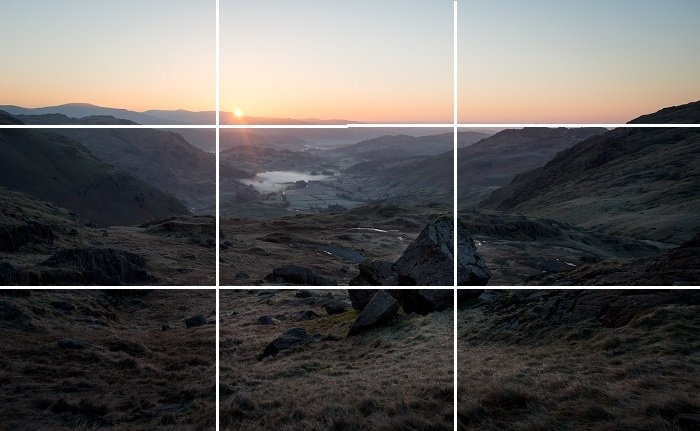
Practical steps to apply the rule of thirds:
- Enable the grid overlay on the camera or phone
- Identify the single most important element in the scene
- Position that element on one of the four intersection points
- For landscapes, place the horizon on the top or bottom third line — never dead center unless symmetry demands it
- Leave "breathing room" in the direction a subject is facing or moving
This one technique alone transforms beginner photos. Our experience shows it takes about two weeks of conscious practice before it becomes instinctive.
Leading Lines and Depth
Leading lines are any lines within the scene that guide the viewer's eye toward the main subject or deeper into the image. Roads, fences, rivers, shorelines, rows of trees, architectural edges — they're everywhere once someone starts looking for them.

Leading lines work best when they start from a corner or edge of the frame and point inward toward the subject. Lines that start from the bottom of the frame and converge toward the top create a powerful sense of depth — this is especially effective in travel photography where conveying the scale of a place matters.
Types of leading lines to look for:
- Converging lines — two parallel lines that appear to meet in the distance (railroad tracks, roads)
- Curved lines — rivers, winding paths, S-curves that add elegance
- Diagonal lines — create energy and movement; more dynamic than horizontal or vertical
- Implied lines — a row of stones, a series of lampposts, or even a person's gaze direction
The Rule of Odds
The human brain finds odd numbers more visually appealing than even numbers. A group of three rocks feels balanced and natural. Four rocks feels static and overly symmetrical. This principle — called the rule of odds — applies to almost any countable subject.

Ways to apply the rule of odds:
- In still life and food photography, arrange three or five items rather than two or four
- When shooting groups, look for clusters of three
- In landscapes, include an odd number of foreground elements (rocks, flowers, trees)
- If an even number exists naturally, adjust the framing to crop one out
This is one of those techniques that sounds minor but makes a noticeable difference once someone starts applying it consistently.
Composition in Action: Real-World Scenarios
Theory is useful, but seeing how these techniques combine in real shooting situations is where everything clicks. Here are scenarios our team encounters regularly, with specific composition advice for each.
Landscape and Travel Photography
Landscape photography lives and dies by composition. The light can be perfect and the location stunning, but a poorly composed landscape photo still falls flat. Our team's approach to landscape composition follows a consistent checklist:
- Find a strong foreground element — rocks, wildflowers, tide pools, or textured ground. This anchors the image and creates depth.
- Place the horizon on a thirds line — top third for dramatic foregrounds, bottom third for dramatic skies.
- Look for leading lines that pull the viewer into the scene.
- Scan the edges for distractions before shooting.
- Try both horizontal and vertical orientations — the best choice isn't always obvious.
Many of these same principles apply when shooting seasonal subjects. Our guides to autumn photography cover how composition choices shift with changing foliage and light conditions.
Everyday and Creative Subjects
Composition isn't just for grand landscapes. It matters in everyday shooting situations too — the kind of photos most people actually take on a regular basis:
- Phone photos at restaurants: Apply the rule of odds when arranging dishes. Shoot from a 45-degree angle with the main dish on a thirds intersection.
- Pet photography: Get down to the animal's eye level. Use leading lines (a leash, a path) to draw attention to the pet.
- Architecture: Look for symmetry first. If the building isn't symmetrical, use leading lines and diagonals to create visual interest.
- Candid family moments: Frame the subject using doorways, windows, or natural frames. Wait for gestures and expressions rather than forcing posed shots.
The best way to internalize composition is to practice it in low-stakes situations. Shooting everyday scenes with intentional composition builds the instinct that kicks in during once-in-a-lifetime moments.
Frequently Asked Questions
What is the most important composition rule for beginners to learn first?
The rule of thirds is the most impactful starting point. It works in virtually every genre of photography, it's easy to practice with grid overlays, and it produces immediately noticeable improvements. Our team recommends spending at least two weeks focusing exclusively on this technique before adding others.
Does photography composition for beginners require an expensive camera?
Not at all. Composition is entirely about how elements are arranged within the frame, and that works the same way on a smartphone as it does on a professional DSLR. Every technique in this guide — rule of thirds, leading lines, rule of odds, framing — applies regardless of the camera being used. Our team has seen stunning compositions shot on basic phone cameras.
How long does it take to develop good composition instincts?
Most people start seeing improvement within two to three weeks of deliberate practice. The key word is deliberate — actively thinking about composition before pressing the shutter rather than shooting and hoping for the best. After about three months of regular shooting with composition in mind, many of these decisions become automatic.
Can post-processing fix bad composition?
Cropping in editing software can salvage some composition issues, but it has limits. Cropping reduces resolution, and it cannot add elements that were never captured. A distracting background can sometimes be darkened or blurred in editing, but getting it right in-camera always produces a superior result. Our team treats post-processing as a refinement tool, not a rescue tool.
Should beginners use more than one composition technique in a single photo?
Absolutely. The strongest photographs often combine multiple techniques — for example, leading lines guiding the eye to a subject placed on a thirds intersection, with an odd number of foreground elements. The techniques are not mutually exclusive. As comfort grows with each individual technique, combining them becomes natural and produces more layered, compelling images.
Next Steps
- Enable the grid overlay on the camera or phone right now, then spend the next two weeks composing every single shot using the rule of thirds — no exceptions, no shortcuts.
- Pick one technique per week after mastering thirds: leading lines in week three, rule of odds in week four, and framing in week five. Photograph at least ten intentional compositions daily using that week's technique.
- Review and critique past photos — go through the last 50 images on the camera roll and identify which composition technique (if any) was used. Crop three of them to improve their composition and compare the before and after.
- Practice the "border patrol" habit on every shot from today forward. Before pressing the shutter, scan all four edges of the frame for distractions. This single habit eliminates the most common beginner composition mistake.
- Study one master photographer's compositions — pick someone whose work resonates and analyze ten of their images specifically for composition choices. Note where subjects are placed, where lines lead, and what was excluded from the frame.
 |
 |
 |
 |

About Alex W.
Alex is a landscape, equine, and pet photographer based in the Lake District, UK, with years of experience shooting in one of Britain's most photographically demanding natural environments. His work has been featured in Take a View Landscape Photographer of the Year, Outdoor Photographer of the Year, and Amateur Photographer Magazine — publications that reflect a serious, competitive standard of image-making. At Click and Learn Photography, he shares the camera settings, gear choices, and compositional techniques he has developed through real-world shooting and competition-level work.
You can Get FREE Gifts. Furthermore, Free Items here. Disable Ad Blocker to receive them all.
Once done, hit anything below
|
|
|
|