Over 60 percent of Nikon DSLR owners eventually purchase a telephoto zoom as their second lens, yet most spend under $300 on it — making this one of the most competitive price brackets in the entire camera lens market. Whether you want to capture wildlife from a safe distance, pull in tight compositions at a sporting event, or simply explore the creative possibilities that extra reach provides, a budget telephoto lens can dramatically expand what your Nikon body is capable of without draining your savings account.

The challenge is that "budget" and "telephoto" sit at opposite ends of the optical engineering spectrum, and manufacturers have to make real trade-offs to keep prices low. You might sacrifice a stop of maximum aperture, settle for a plastic mount instead of metal, or accept slightly slower autofocus in dim conditions. The good news heading into 2026 is that refurbished and renewed options from Nikon, Tamron, and Sigma have pushed effective prices even lower, so you can get genuinely capable glass for the cost of a nice dinner out. If you are still building out your gear zone, a telephoto zoom deserves a spot near the top of your list.
In this roundup we evaluate seven of the most popular budget telephoto lenses compatible with Nikon F-mount DSLRs, covering focal ranges from 55-200mm all the way out to 70-300mm. We have tested sharpness, autofocus speed, vibration reduction effectiveness, and build quality so you can make an informed decision. Each lens occupies a slightly different niche, and your ideal pick will depend on whether you prioritize maximum reach, image stabilization, macro capability, or simply the lowest possible price.
Contents
Top Rated Picks of 2026
- #PreviewProductRating
- Bestseller No. 1
 Rating:

- Bestseller No. 2
 Rating:
 - Bestseller No. 3
 Rating:
 - Bestseller No. 4
 Rating:
 - Bestseller No. 5
 Rating:
 - Bestseller No. 6
 Rating:
 - Bestseller No. 7
 Rating:
Our Hands-On Reviews
1. Nikon AF-S DX NIKKOR 55-300mm f/4.5-5.6G ED VR — Best Overall Reach for DX Shooters
The Nikon 55-300mm f/4.5-5.6G ED VR remains one of the most versatile budget telephotos Nikon has ever produced for its DX crop-sensor bodies. With a 5.5x zoom range that translates to an effective 82.5-450mm in 35mm terms, you get a genuinely impressive amount of reach packed into a lens that weighs just over a pound. The built-in Vibration Reduction system works well enough to let you shoot handheld at moderate shutter speeds, which is essential when you are tracking birds or shooting from the sidelines at a school sports event without a monopod.
Optical quality is respectable for the price tier, with two ED glass elements helping to tame chromatic aberration through most of the zoom range. Sharpness is best between 55mm and 200mm, where center resolution is quite good, though it does soften noticeably past 250mm as you push toward maximum reach. Nikon's Silent Wave Motor provides autofocus that is reasonably quick and nearly silent, which matters if you are shooting video or photographing in quiet environments. The 58mm filter thread is a common and inexpensive size, so adding a UV or polarizing filter will not break the bank.
Where the lens shows its budget roots is in build quality — the barrel is entirely plastic, including the mount, and the zoom ring can feel a bit loose after extended use. If you are shooting in mountain landscapes or other rugged conditions, you will want to handle it with a little extra care. That said, as a certified refurbished unit it represents excellent value, and the 90-day warranty provides a reasonable safety net.
Pros:
- Excellent 5.5x zoom range covers everything from portraits to distant wildlife
- Effective VR system allows handheld shooting at slower shutter speeds
- Silent Wave Motor delivers quiet and accurate autofocus performance
- Two ED glass elements reduce chromatic aberration throughout the range
Cons:
- Image sharpness drops off noticeably beyond the 250mm mark
- All-plastic construction including the lens mount feels fragile
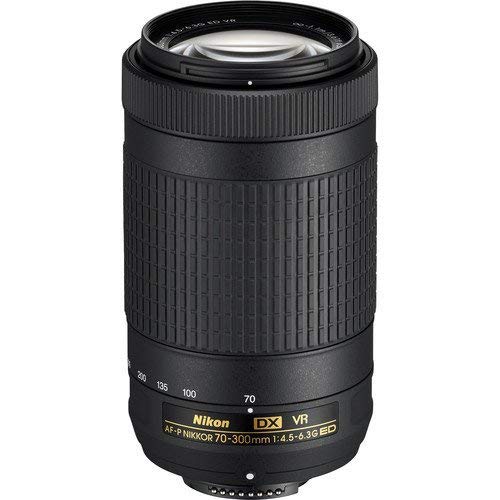
2. Nikon AF-P DX NIKKOR 70-300mm f/4.5-6.3G ED VR — Best Autofocus Speed on a Budget
If autofocus speed is your top priority and you want to keep costs down, the AF-P version of Nikon's 70-300mm is arguably the best option in this roundup. The "P" in AF-P stands for pulse motor technology, which is a stepping motor that delivers significantly faster and smoother focusing than the older screw-drive or even Silent Wave Motor designs. This makes it particularly well-suited for tracking moving subjects, whether that is your kid running across a soccer field or a bird in flight. On a DX body the equivalent focal range of 105-450mm gives you serious telephoto reach.
Optically the lens includes one Extra-Low Dispersion element that helps control fringing, and center sharpness is genuinely impressive from 70mm through about 200mm. Beyond that you will see the typical softening that comes with budget telephoto designs, though stopping down to f/8 or f/11 brings the corners into acceptable territory. The VR system claims around four stops of stabilization, and in practice you can reliably handhold sharp images at 300mm down to about 1/80th of a second in good light, which is a meaningful advantage over non-stabilized alternatives.
There is one important compatibility caveat to be aware of: the AF-P motor system is not fully compatible with older Nikon bodies. If you are using a D3200, D5200, or anything older than those, the lens may not autofocus or even be recognized by the camera. Check Nikon's compatibility list before purchasing. On supported bodies, however, this lens punches well above its weight class for the price, and the renewed pricing makes it one of the most affordable ways to get stabilized 300mm reach on a Nikon DX system in 2026.
Pros:
- Pulse motor autofocus is the fastest and quietest in this price bracket
- Effective VR stabilization allows handheld shooting at slow shutter speeds
- Compact and lightweight design does not add excessive bulk to your kit
- Strong center sharpness from 70mm through 200mm at most apertures
Cons:
- Not compatible with many older Nikon DSLR bodies due to AF-P motor
- Maximum aperture of f/6.3 at the long end is quite slow for low light
3. Nikon 70-300mm f/4.5-5.6G ED IF AF-S VR — Best for Full-Frame Compatibility
Unlike the first two DX-only lenses in this list, the Nikon 70-300mm f/4.5-5.6G ED IF AF-S VR is designed for full-frame FX bodies as well as DX cameras, which makes it a smart purchase if you are considering an upgrade to a full-frame Nikon down the road. The Internal Focus system means the front element does not rotate during focusing, which is convenient if you use polarizing filters, and the barrel length stays constant throughout the zoom range. The lens offers two focus modes — M/A for manual override during autofocus, and full manual — giving you flexibility when fine-tuning focus on stationary subjects.
Image quality is a step above the DX-only options at the wider end of the zoom range, with notably good contrast and color rendition from 70mm through 200mm. The ED glass element does a respectable job of controlling chromatic aberration, though you will still see some purple fringing on high-contrast edges at 300mm. The VR system performs well, and the minimum focus distance of 4.9 feet allows you to get reasonably close to small subjects, which is a nice bonus for casual close-up work even though this is not a dedicated macro lens.
The Silent Wave Motor provides quick and quiet autofocus, though it is not quite as fast as the AF-P pulse motor found in the second lens on our list. Build quality is solid for a consumer-grade Nikon lens, with a metal mount that inspires more confidence than the all-plastic mounts on the DX alternatives. At renewed pricing this represents a strong value proposition, especially for photographers who want a lens that will grow with them if they eventually move to full-frame.
Pros:
- Full-frame FX compatible, so it works on both DX and FX Nikon bodies
- Internal Focus keeps barrel length constant and avoids filter rotation
- Metal lens mount provides a more durable and secure body connection
- M/A focus mode allows seamless manual override during autofocus
Cons:
- Heavier and larger than the DX-only alternatives in this roundup
- Sharpness drops at 300mm, especially when shooting wide open
4. Tamron AF 70-300mm f/4.0-5.6 SP Di VC USD XLD — Best Third-Party Optics
Tamron's SP (Super Performance) line has always aimed to punch above its weight class, and the 70-300mm f/4.0-5.6 VC USD XLD is a compelling example of that ambition. The standout feature here is the XLD (Extra Low Dispersion) glass element, which delivers noticeably better chromatic aberration control than what you find in most budget telephotos. Colors are clean and punchy, and the resolution holds up surprisingly well through 200mm, with only moderate softening at the extreme long end. For a third-party lens in this price range, the optical quality is genuinely impressive.
The USD (Ultra Silent Drive) motor provides autofocus that is both fast and whisper-quiet, competitive with Nikon's own Silent Wave Motor in real-world use. Tamron's VC (Vibration Compensation) system is effective and smooth, offering roughly three stops of stabilization that make a noticeable difference when you are shooting handheld at longer focal lengths. The lens is full-frame compatible, so it works on both DX and FX Nikon bodies, giving you the same upgrade path flexibility as the Nikon 70-300mm AF-S VR above.
Build quality is where the SP designation really shows — the lens feels more substantial in hand than either of the Nikon DX options, with a metal mount and smooth, well-damped zoom and focus rings. There is one important compatibility note printed right on the product listing: this lens is not compatible with the Nikon 1 FT1 adapter with firmware 1.1, so if you were planning to use it on a Nikon 1 mirrorless body, you will need to look elsewhere. For DSLR shooters, however, this is one of the best-performing budget telephotos available.
Pros:
- XLD glass delivers superior chromatic aberration correction at this price
- USD motor provides fast and nearly silent autofocus performance
- Effective VC stabilization system with approximately three stops of benefit
- SP-grade build quality with metal mount and well-damped control rings
Cons:
- Not compatible with Nikon 1 FT1 adapter at firmware 1.1
- Slightly heavier than comparable Nikon DX options due to FX coverage
5. Tamron AF 70-300mm f/4.0-5.6 Di LD Macro — Best Budget Macro-Telephoto Combo
If you want telephoto reach and basic macro capability in a single affordable lens, the Tamron 70-300mm Di LD Macro is worth serious consideration. The headline feature is a dedicated macro mode that delivers a 1:2 magnification ratio, which is half life-size and far more capable than the close-focus distances offered by the other lenses in this roundup. For photographing flowers, insects, or small products, this macro mode can save you from needing to buy a separate macro lens early on, though serious macro enthusiasts will eventually want dedicated macro photography equipment for true 1:1 reproduction.
This version of the lens includes a built-in motor (the A17NII model), which is critical because it means the lens will autofocus on Nikon bodies that lack a screw-drive AF motor, such as the popular D3000, D5000, and D3500 series. Autofocus speed is adequate for general use, though it is noticeably slower than the USD motor found in Tamron's higher-end SP version, and you will hear the motor working during focus acquisition. For sports or fast action, you may find the AF tracking struggles to keep up with rapidly moving subjects.
Optical quality is honest for the price — sharp enough in the center at moderate focal lengths, with some softness creeping in at the edges and at the 300mm extreme. The LD (Low Dispersion) element helps with chromatic aberration, though it is not as effective as the XLD glass in the SP model above. There is no optical stabilization built into this lens, so you will need to rely on faster shutter speeds or steady technique when shooting at the long end, which limits its usefulness in low-light situations.
Pros:
- Macro mode with 1:2 magnification ratio adds genuine close-up versatility
- Built-in AF motor works with all Nikon DSLR bodies including entry-level
- Typically the lowest-priced 70-300mm option available for Nikon mount
Cons:
- No optical stabilization, which limits handheld shooting at longer focal lengths
- Autofocus motor is audibly louder and slower than SWM or USD alternatives
- Optical quality drops off considerably beyond 200mm at wider apertures
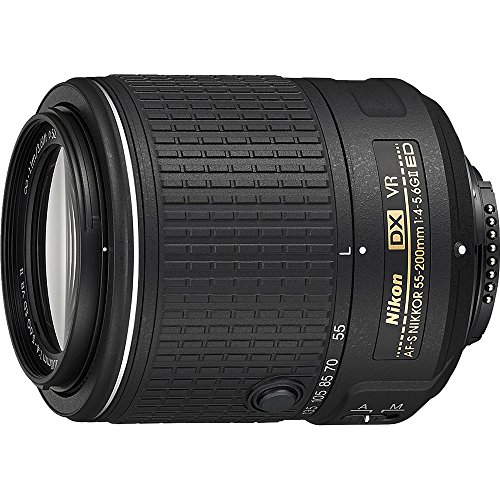
6. Nikon 55-200mm f/4-5.6G VR II DX AF-S ED — Best Compact Travel Telephoto
When size and weight matter more than maximum reach, the Nikon 55-200mm f/4-5.6G VR II is the most compact telephoto option in this roundup by a significant margin. It is designed specifically as a travel-friendly companion that pairs well with Nikon's smaller DX bodies like the D3500 or D5600, and the reduced zoom range compared to 70-300mm alternatives means fewer optical compromises in the focal lengths it does cover. If you enjoy travel photography and want a telephoto that will not weigh down your bag, this lens is hard to beat.
Nikon's Super Integrated Coating is a real benefit here, delivering clean color rendition with minimal ghosting and lens flare, which is something you will appreciate when shooting into backlit scenes or near strong light sources. The VR II stabilization system is the updated second-generation version, offering approximately four stops of correction, and it genuinely works well enough that you can shoot handheld at 200mm in reasonable light without worrying about camera shake. Autofocus is handled by a Silent Wave Motor that is quick and unobtrusive.
The trade-off for all that compactness is obvious — you top out at 200mm instead of 300mm, which gives you an effective reach of 300mm on a DX body compared to 450mm with the longer alternatives. For wildlife, distant sports, or any situation where you need to crop in tight on a faraway subject, that 100mm difference is meaningful. But if your telephoto needs tend toward portraits, casual sports, and travel snapshots where 200mm provides enough reach, the size and weight savings make this a very compelling choice.
Pros:
- Most compact and lightweight telephoto zoom in this entire roundup
- VR II stabilization is effective and provides roughly four stops of benefit
- Super Integrated Coating reduces ghosting and flare in backlit situations
- Sharp optics through the entire 55-200mm range with consistent performance
Cons:
- Maximum reach of 200mm is significantly shorter than 300mm competitors
- DX-only lens with no upgrade path to full-frame Nikon bodies
7. Sigma 70-300mm f/4-5.6 DG APO Macro — Best Full-Frame Value with Macro
Sigma's 70-300mm f/4-5.6 DG APO Macro rounds out our list as a full-frame compatible option that combines telephoto reach with macro capability at a price that frequently undercuts everything else in this comparison. The APO (Apochromatic) designation means Sigma has used special low-dispersion glass elements to correct chromatic aberration across the zoom range, and the results are quite good for the money — colors are clean and fringing is well-controlled at most focal lengths. The macro mode offers 1:2 magnification with a minimum focusing distance of 59 inches, which gives you useful close-up capability without switching lenses.
At just 19.4 ounces and 4.8 inches in length, this is an extremely compact package for a full-frame 70-300mm lens, making it a practical choice for photographers who want reach without bulk. The motorized autofocus works with all Nikon DSLR bodies, and the DG optical design means the lens covers the full-frame image circle, so you can use it on FX bodies now or in the future. On DX crop-sensor cameras the effective focal range stretches to approximately 100-450mm, giving you impressive reach for wildlife and distant subjects.
The main limitation is the lack of any optical stabilization, which is a notable omission in 2026 when most competitors offer at least basic VR or VC. At 300mm on a non-stabilized lens you will need shutter speeds of at least 1/500th to consistently get sharp handheld results, and that demands either bright light or higher ISO settings. Autofocus speed is adequate but not exceptional, placing it somewhere between the Tamron LD's noisy motor and the quicker SWM or USD options from Nikon and Tamron. If you are primarily shooting in good light and want the combination of full-frame compatibility, macro mode, and APO-corrected optics at the lowest possible cost, the Sigma delivers solid results.
Pros:
- APO glass provides effective chromatic aberration correction across the range
- Extremely compact and lightweight at 19.4 ounces and 4.8 inches long
- Full-frame DG design compatible with both DX and FX Nikon bodies
- Macro mode with 1:2 magnification for versatile close-up shooting
Cons:
- No optical stabilization system, requiring faster shutter speeds throughout
- Autofocus speed is moderate and may struggle with fast-moving subjects
Key Features to Consider When Choosing a Budget Telephoto Lens
Focal Length Range and Crop Factor
The focal length range determines how far you can reach and how tight you can frame distant subjects, but the numbers on the lens barrel only tell half the story. On a Nikon DX crop-sensor body, you need to multiply the focal length by 1.5x to get the effective equivalent, so a 70-300mm lens behaves more like a 105-450mm on your camera. If you are primarily shooting wildlife or sports from a distance, the extra reach of a 300mm lens (450mm equivalent on DX) makes a meaningful difference compared to a 200mm option that tops out at 300mm equivalent. Consider what you actually want to photograph and how close you can physically get to your subjects before deciding whether 200mm is enough or you truly need 300mm.
Vibration Reduction and Stabilization
Optical stabilization — called VR by Nikon, VC by Tamron — is arguably the most important feature to prioritize in a budget telephoto lens. At focal lengths above 200mm, even small hand movements translate into visible blur, and the general rule of thumb is that your minimum shutter speed should match your effective focal length (so 1/450th of a second at 300mm on DX). A good stabilization system buys you three to four stops of extra leeway, meaning you can shoot at 1/60th instead of 1/450th and still get sharp results. Two of the seven lenses in this roundup lack stabilization entirely, and while they compensate with lower prices or other features, the absence of VR or VC is a real limitation for handheld shooting in anything less than bright daylight.
Autofocus Motor Type and Speed
Budget telephoto lenses use several different autofocus motor technologies, and the type of motor affects both speed and noise levels significantly. Nikon's AF-P pulse motor is the fastest and quietest option in this roundup, followed closely by the Silent Wave Motor (AF-S) and Tamron's USD motor, all of which are suitable for continuous autofocus tracking of moving subjects. Older screw-drive and basic motor designs — like the one in the Tamron Di LD — are noticeably slower and louder, which can be a problem for video work or photographing in quiet environments. If you plan to shoot any kind of action photography, prioritize a lens with SWM, USD, or pulse motor technology.
DX vs FX Compatibility and Future-Proofing
Three of the lenses in this roundup are DX-only, meaning they project an image circle sized for crop-sensor bodies and will vignette heavily on full-frame FX cameras. The other four are designed for full-frame coverage and work perfectly on both DX and FX bodies. If you are currently shooting on a DX body but have any plans to eventually upgrade to a Nikon D750, D780, or Z-series full-frame camera, spending a little extra for an FX-compatible telephoto now can save you from having to replace it later. That said, if you are committed to the DX system and have no upgrade plans, the DX-only options tend to be smaller, lighter, and sometimes sharper because they only need to cover the smaller sensor area.
FAQs
What is the best budget telephoto lens for Nikon in 2026?
The best budget telephoto for your Nikon depends on your specific priorities, but the Nikon AF-P DX NIKKOR 70-300mm f/4.5-6.3G ED VR offers the best combination of autofocus speed, stabilization, and image quality for DX shooters, while the Tamron SP 70-300mm VC USD XLD provides the best overall optical performance for photographers who want full-frame compatibility.
Can I use a DX telephoto lens on a full-frame Nikon body?
You can physically mount a DX lens on an FX body, and most modern Nikon full-frame cameras will automatically crop to DX mode, but you will lose a significant portion of your sensor resolution because the camera is only using the center portion of the sensor. For the best results on full-frame bodies, choose a lens with FX or DG compatibility like the Nikon 70-300mm AF-S VR, the Tamron SP VC USD, or the Sigma APO Macro.
Is vibration reduction necessary for a telephoto lens?
While not strictly necessary, vibration reduction makes a substantial practical difference for handheld telephoto shooting. At 300mm on a DX body (450mm equivalent), you would need a shutter speed of at least 1/500th without stabilization to avoid camera shake blur, which limits you to bright outdoor conditions or high ISO settings. VR or VC systems typically provide three to four stops of benefit, allowing you to shoot handheld in a much wider range of lighting conditions.
Are refurbished and renewed lenses safe to buy?
Certified refurbished lenses sold through Amazon's Renewed program go through functionality testing, cleaning, and inspection before being repackaged, and they come with a minimum 90-day warranty. While they may show limited cosmetic wear, they are verified to perform like new optically and mechanically. For budget-conscious photographers, renewed telephoto lenses offer significant savings with minimal risk, though you should always verify the return policy before purchasing.
What is the difference between AF-S and AF-P Nikon lenses?
AF-S lenses use Nikon's Silent Wave Motor, which is an ultrasonic-type motor that provides fast and quiet autofocus, while AF-P lenses use a newer pulse stepping motor that is even faster and smoother, particularly for video autofocus. The key difference is compatibility — AF-P lenses require newer Nikon bodies (generally D3300 and later) to function properly, while AF-S lenses work with virtually all Nikon DSLRs that support autofocus lenses.
Can these budget telephoto lenses be used for astrophotography?
Budget telephoto lenses can capture basic moon photography and wide-field images of star clusters or the Milky Way, but they are not ideal for serious astrophotography due to their relatively slow maximum apertures (f/4.5-5.6 or slower). For deep-sky imaging, you would want a faster lens with an aperture of f/2.8 or wider, as well as a sturdy tripod and tracking mount to compensate for the lack of light-gathering ability at these budget aperture ranges.
Buy on Walmart
- Nikon AF-S DX NIKKOR 55-300mm f/4.5-5.6G ED Vibration Reduct — Walmart Link
- Nikon AF-P DX NIKKOR 70-300mm f/4.5-6.3G ED VR Lens for Niko — Walmart Link
- Nikon 70-300mm f/4.5-5.6G ED IF AF-S VR Nikkor Zoom Lens for — Walmart Link
- Tamron AF 70-300mm f/4.0-5.6 SP Di VC USD XLD for Nikon Digi — Walmart Link
- Tamron Auto Focus 70-300mm f/4.0-5.6 Di LD Macro Zoom Lens w — Walmart Link
- Nikon 55-200mm f/4-5.6G VR II DX AF-S ED Zoom-Nikkor Lens (R — Walmart Link
- Sigma 70-300mm f/4-5.6 DG APO Macro Motorized Telephoto Zoom — Walmart Link
Buy on eBay
- Nikon AF-S DX NIKKOR 55-300mm f/4.5-5.6G ED Vibration Reduct — eBay Link
- Nikon AF-P DX NIKKOR 70-300mm f/4.5-6.3G ED VR Lens for Niko — eBay Link
- Nikon 70-300mm f/4.5-5.6G ED IF AF-S VR Nikkor Zoom Lens for — eBay Link
- Tamron AF 70-300mm f/4.0-5.6 SP Di VC USD XLD for Nikon Digi — eBay Link
- Tamron Auto Focus 70-300mm f/4.0-5.6 Di LD Macro Zoom Lens w — eBay Link
- Nikon 55-200mm f/4-5.6G VR II DX AF-S ED Zoom-Nikkor Lens (R — eBay Link
- Sigma 70-300mm f/4-5.6 DG APO Macro Motorized Telephoto Zoom — eBay Link
Key Takeaways
- The Nikon AF-P DX 70-300mm VR stands out for its pulse motor autofocus speed and effective stabilization, making it the strongest all-around pick for DX shooters who want fast and reliable telephoto performance on a budget.
- If you value optical quality above all else and want full-frame compatibility for future upgrades, the Tamron SP 70-300mm VC USD XLD delivers the best image quality in this price range thanks to its XLD glass and solid SP-grade build.
- Photographers who need both telephoto reach and close-up macro capability without buying a second lens should consider the Tamron Di LD Macro or Sigma APO Macro, both of which offer 1:2 magnification ratios at bargain prices.
- Always prioritize a lens with optical stabilization (VR or VC) unless you shoot exclusively in bright conditions, because stabilization makes a larger practical difference than any other single feature when shooting handheld at 200mm and beyond.
 |
 |
 |
 |

About Alex W.
Alex is a landscape, equine, and pet photographer based in the Lake District, UK, with years of experience shooting in one of Britain's most photographically demanding natural environments. His work has been featured in Take a View Landscape Photographer of the Year, Outdoor Photographer of the Year, and Amateur Photographer Magazine — publications that reflect a serious, competitive standard of image-making. At Click and Learn Photography, he shares the camera settings, gear choices, and compositional techniques he has developed through real-world shooting and competition-level work.
You can Get FREE Gifts. Furthermore, Free Items here. Disable Ad Blocker to receive them all.
Once done, hit anything below
|
|
|
|