Landscape Photography – Benefits of Shooting Locally vs Travelling
by Alex W.
Both local and travel landscape photography produce stunning results — the real question is which approach builds skills faster and fits a photographer's lifestyle. Our team's stance on landscape photography local vs traveling is straightforward: most photographers should master their home turf first, then use travel as a creative catalyst rather than a crutch. The two approaches complement each other, and dismissing either one means leaving growth on the table.

We've spent years shooting landscapes within a 30-minute drive of home and across multiple countries. The portfolio pieces that consistently earn the most attention? A surprising number came from familiar locations revisited dozens of times. That said, travel photography forces creative problem-solving that nothing else replicates. Here's our breakdown of how both approaches work together for long-term improvement.
Contents
- Local vs Travel Landscape Photography: Weighing the Trade-Offs
- Gear Considerations for Local and Travel Shoots
- Mistakes That Stall Landscape Photography Progress
- When Shooting Locally Delivers Better Results
- Real-World Lessons from Shooting Both Ways
- Building a Sustainable Landscape Photography Practice
- Keeping Skills and Equipment Sharp Between Trips
- Frequently Asked Questions
- Final Thoughts
Local vs Travel Landscape Photography: Weighing the Trade-Offs
The landscape photography local vs traveling debate usually frames one as superior. That's the wrong lens. Each approach offers distinct advantages, and understanding these trade-offs helps anyone allocate time and budget more effectively.
Advantages of Shooting Locally
- Repeat access — returning to the same spot across seasons, weather, and light conditions produces images that one-time visitors simply cannot capture
- Zero travel costs mean more budget for lenses, filters, or editing tools
- Intimate knowledge of a location's micro-conditions (where fog collects, when reflections align) creates a genuine creative edge
- Failure costs nothing — a bad sunrise means driving home and trying again tomorrow
- Local portfolios often feel more cohesive and personal than scattered travel collections
Advantages of Travel Photography
- Novel subjects force adaptation — unfamiliar terrain breaks compositional habits and pushes creative boundaries
- Iconic locations provide built-in visual impact that's harder to achieve with everyday scenery
- Travel creates urgency that sharpens decision-making under pressure
- Exposure to different ecosystems, light qualities, and cultural landscapes broadens artistic range
- The experience itself fuels motivation and prevents creative burnout
| Factor | Local Shooting | Travel Shooting |
|---|---|---|
| Cost per session | Low (fuel only) | High (flights, lodging, permits) |
| Skill development speed | Fast (high repetition) | Moderate (intense but infrequent) |
| Subject variety | Limited without creativity | Naturally diverse |
| Weather flexibility | High (reschedule easily) | Low (fixed dates) |
| Portfolio uniqueness | High (personal vision) | Moderate (shared locations) |
| Planning required | Minimal | Extensive |
| Creative pressure | Low | High |
Gear Considerations for Local and Travel Shoots
The gear equation shifts significantly depending on whether a shoot is local or abroad. Our team approaches each scenario differently, and getting the kit right prevents frustration in the field.
The Local Kit
Local sessions allow for a heavier, more specialized setup. There's no reason to compromise when the car is parked 10 minutes away.
- Full-size tripod with a heavy ball head — stability matters more than portability
- Multiple lens options, including specialized glass like a telephoto for compression effects
- Full filter kit (graduated NDs, polarizer, 6-stop and 10-stop ND filters)
- Remote shutter release and intervalometer for long exposures
- Extra batteries and memory cards without weight concern
The Travel Kit
Travel demands ruthless minimalism. Every item must justify its weight. Our recommendation: one wide-angle zoom, one mid-range prime, and a travel tripod. That covers 90% of landscape scenarios. Anyone debating camera systems for travel should consider the weight savings of mirrorless over DSLR — it adds up across long hikes.
Mistakes That Stall Landscape Photography Progress
Whether shooting locally or traveling, certain mistakes show up repeatedly. Recognizing them early saves months of frustration.
Local Shooting Pitfalls
- Dismissing familiar scenery as boring — this is the single biggest mistake. Ordinary locations in extraordinary light produce extraordinary photographs
- Always shooting the same composition from the same angle at the same time of day
- Neglecting to shoot in poor weather — overcast skies, rain, and mist create the most dramatic local images
- Waiting for "perfect conditions" instead of working with what's available
- Ignoring the value of understanding exposure fundamentals at a deeply intuitive level through repetition
Travel Shooting Pitfalls
- Trying to visit too many locations instead of spending quality time at fewer spots
- Only photographing the "postcard" angle everyone else shoots
- Skipping scouting because of time pressure, then arriving unprepared for the light
- Overpacking gear and being too exhausted to hike to the best vantage points
- Not shooting RAW — travel light is often challenging, and RAW files preserve the latitude needed to recover highlights and shadows in post
When Shooting Locally Delivers Better Results
There are specific scenarios where local shooting isn't just "good enough" — it's objectively superior to travel photography.
Chasing Specific Conditions
Certain atmospheric conditions are impossible to schedule around a travel itinerary. Morning fog, golden hour light after a storm, first frost, or rare cloud formations all demand the ability to drop everything and shoot within minutes. Local photographers who track weather patterns and keep a bag packed by the door capture images that traveling photographers never will.
Long-Form Projects
Some of the most compelling landscape work is built over months or years:
- Seasonal series documenting one location through all four seasons
- Tidal studies at a single coastline
- Urban-rural boundary documentation as areas develop
- Night sky progressions from the same foreground across different moon phases
These projects demand consistency and proximity that travel cannot provide. They also produce deeply personal bodies of work that stand apart from the flood of generic mountain photography from popular destinations.
Real-World Lessons from Shooting Both Ways
Our team has learned hard lessons from both approaches. Here are the insights that actually changed how we work.
Local Breakthroughs
One of our most-shared images came from a reservoir we'd driven past hundreds of times. On a morning when fog sat perfectly at water level and the sun punched through at a low angle, everything aligned. That image happened because we knew exactly when and where the fog would form based on previous failed attempts at that spot. A visitor would never have been there at that moment.
Another lesson: shooting the same woodland path across every season taught us more about composition principles than any workshop. When the subject stays constant, compositional changes become the only variable — and the learning accelerates dramatically.
Travel Breakthroughs
Travel forced us to break habits we didn't know we had. Shooting in Iceland, the scale of the landscape demanded wider compositions than we'd ever attempted. In Southeast Asia, the quality of tropical light at midday challenged our golden-hour-only mindset.
The biggest travel lesson: constraints breed creativity. Limited time at a location forces faster decision-making about composition, focal length, and exposure. That pressure-tested instinct carries over to local shooting and makes every session more productive.
Building a Sustainable Landscape Photography Practice
The photographers who improve fastest treat landscape photography local vs traveling as a planned ratio, not random chance. Here's the framework our team uses.
Balancing Local and Travel Sessions
- Establish a weekly local routine — even one sunrise session per week builds rapid familiarity with light and location
- Identify 3-5 local spots within 30 minutes and rotate through them systematically
- Plan 2-4 dedicated travel shoots per year with specific creative goals (not just "take pretty pictures")
- After each trip, apply at least one new technique learned abroad to a local location
- Review local and travel portfolios separately every quarter — look for gaps in technique or subject matter
Portfolio Development
A strong landscape portfolio blends both approaches. Local work demonstrates depth, patience, and artistic vision. Travel work demonstrates versatility and ambition. Portfolio reviewers and editors notice when a photographer can produce compelling images from any environment — not just famous destinations.
Our recommendation: aim for a 60/40 split favoring local work in the portfolio. This signals mastery of light and composition rather than reliance on dramatic scenery.
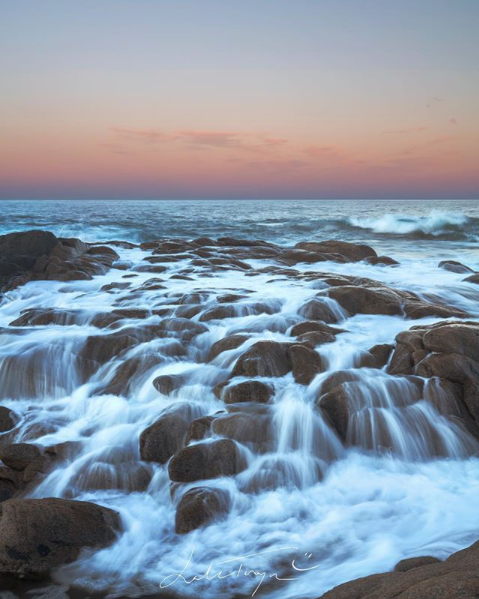
A photo taken in my early days, complete with old cringe watermark. My skills have since developed, and I've been waiting forever to recreate this image.
Keeping Skills and Equipment Sharp Between Trips
The gap between travel trips is where most photographers stagnate. Treating local shooting as deliberate practice — not just casual snapping — prevents skill decay and keeps gear in working condition.
Technique Drills at Home
- Practice long exposures at local waterways to nail filter stacking and exposure calculation
- Shoot handheld at twilight to push high-ISO technique and steady-hand discipline
- Experiment with focal length extremes — ultra-wide one session, telephoto the next
- Try black and white landscape work to sharpen tonal awareness without the distraction of color
- Revisit old compositions with new post-processing techniques to track improvement
Equipment Maintenance
Gear that sits idle between trips deteriorates. Regular local use is the best equipment maintenance program. Batteries hold charge better with regular cycling, tripod joints stay smooth with use, and lens elements get inspected naturally. Beyond that:
- Clean sensor and rear elements after every field session
- Check tripod leg locks and ball head tension monthly
- Store filters in protective cases, not loose in bags
- Update camera firmware during quiet periods, not the night before a trip
- Test backup batteries under cold conditions locally before relying on them abroad
Frequently Asked Questions
Is local landscape photography as rewarding as travel photography?
Absolutely. Local shooting builds a deeper connection with the environment and often produces more personal, distinctive work. The reward comes from mastering light and conditions rather than relying on dramatic scenery. Many award-winning landscape images come from photographers' home regions.
How often should landscape photographers travel for shoots?
Our team recommends 2-4 dedicated trips per year for most hobbyist photographers. Each trip should have a clear creative goal. More frequent local sessions (weekly or biweekly) fill the gaps and keep skills progressing between trips.
What's the best way to find local landscape photography locations?
Start with topographic maps, satellite imagery, and local hiking trail databases. Scout at different times of day. Ask local photography groups for lesser-known spots. Parks, rivers, reservoirs, farmland, and coastal areas within 30 minutes often provide more variety than most people assume.
Does landscape photography local vs traveling affect which gear to buy?
It should influence priorities. Photographers who primarily shoot locally can invest in heavier, more specialized equipment like large tripods and extensive filter sets. Travel-focused photographers should prioritize lightweight mirrorless systems and versatile zoom lenses that cover wide-to-telephoto ranges.
How do professional landscape photographers balance local and travel work?
Most professionals maintain a strong local practice as the foundation of their workflow. Travel is planned around specific projects, commissions, or portfolio gaps. The local work funds and informs the travel work, creating a sustainable cycle rather than relying solely on expensive trips.
Can local landscape photography help prepare for travel shoots?
Without question. Local shooting is the best training ground for travel. Mastering exposure, composition, and timing at familiar locations means less fumbling and more creating when time is limited abroad. Every technique practiced locally transfers directly to unfamiliar terrain.
What's the biggest mistake in landscape photography travel planning?
Cramming too many locations into one trip. Spending two full days at one location — covering sunrise, midday, and sunset — produces better results than visiting five locations in five days. Depth beats breadth every time, and this mirrors the same lesson local shooting teaches through repetition.
Final Thoughts
The landscape photography local vs traveling question isn't either/or — it's about finding the right balance. Our strongest recommendation is to pick one local spot this week, commit to shooting it in three different lighting conditions, and notice how much more intentional each visit becomes. That foundation of local mastery makes every future trip more productive, more creative, and far more rewarding than showing up at a famous location and hoping for the best.
 |
 |
 |
 |

About Alex W.
Alex is a landscape, equine, and pet photographer based in the Lake District, UK, with years of experience shooting in one of Britain's most photographically demanding natural environments. His work has been featured in Take a View Landscape Photographer of the Year, Outdoor Photographer of the Year, and Amateur Photographer Magazine — publications that reflect a serious, competitive standard of image-making. At Click and Learn Photography, he shares the camera settings, gear choices, and compositional techniques he has developed through real-world shooting and competition-level work.
You can Get FREE Gifts. Furthermore, Free Items here. Disable Ad Blocker to receive them all.
Once done, hit anything below
|
|
|
|