A recent survey of professional landscape photographers revealed that over 40% shoot with just a single lens for the majority of their fieldwork. That number surprised our team at first, but after years of practicing one lens landscape photography, we understand exactly why. Carrying less gear, thinking more creatively, and mastering a single focal length has transformed the way we approach landscape photography as a whole. The idea sounds counterintuitive — why limit options when nature offers infinite compositions? But the constraints are precisely what make this approach so powerful.

Our team has spent considerable time experimenting with multi-lens kits, prime-only setups, and everything in between. The conclusion we keep returning to is simple: one well-chosen lens forces better decision-making in the field. Instead of fumbling through a bag swapping glass, the photographer moves — physically repositioning, rethinking foreground elements, and engaging with the scene on a deeper level. That kind of discipline produces stronger images, period.
This isn't about being cheap or lazy. It's about adopting a philosophy that strips away distractions and puts composition front and center. Below, we'll break down why this approach works, how to implement it, and which focal lengths deserve consideration.
Contents
The Single-Lens Mindset: Beginner Trap or Advanced Strategy?
There's a persistent myth that more lenses equal more creative potential. Gear marketing reinforces this constantly. But the relationship between equipment and output isn't linear — and our experience confirms that the diminishing returns kick in fast.
Why Beginners Default to Multiple Lenses
Most people starting out in landscape photography naturally gravitate toward building a lens collection. The logic feels sound:
- Wide-angle for sweeping vistas
- Telephoto for compressed mountain layers
- Mid-range zoom for "everything else"
- A fast prime for low-light situations
The problem is that carrying four lenses creates decision paralysis in the field. When standing before a stunning sunrise — those fleeting moments described well in this guide to shooting landscapes at sunrise — the last thing anyone needs is to debate which lens to mount. Our team has watched countless workshop participants miss golden light while swapping glass. The moment passes. The shot is gone.
Why Experienced Shooters Simplify
Seasoned landscape photographers tend to converge on fewer lenses over time. It's not coincidence. After thousands of hours in the field, patterns emerge:
- 80% of keeper shots come from one focal range
- Lens swaps in harsh conditions risk sensor dust and moisture damage
- Lighter packs mean longer hikes and access to better locations
- Creative constraints breed innovation — the photographer moves instead of zooming
The legendary photographer Ansel Adams frequently returned to the same locations with the same equipment. Mastery came from understanding light and composition, not from owning every focal length available.
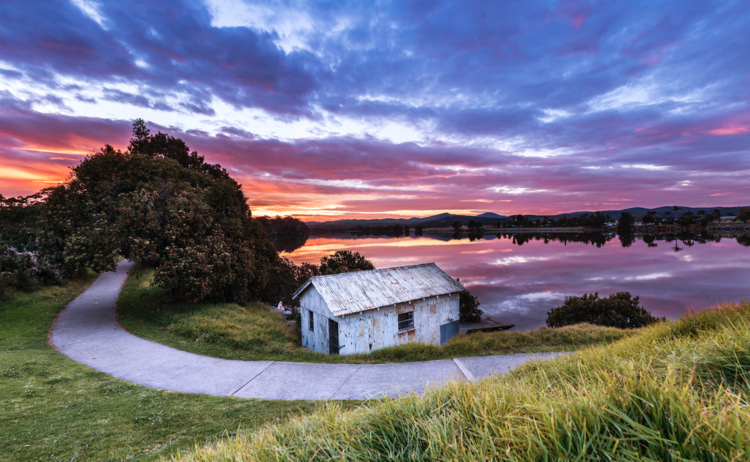
The only way I could fit the walking path in was, you guessed it, a pano!
How to Shoot One Lens Landscape Photography Step by Step
Transitioning to a single-lens workflow isn't something that happens overnight. Our team recommends a deliberate, phased approach that builds confidence and reveals personal shooting patterns.
Choosing a Focal Length
Before committing, it helps to audit existing work. Here's the process we follow:
- Review the last 200 landscape images in Lightroom or any cataloging tool. Check the EXIF data for focal length.
- Note which focal length appears most frequently in the keepers — not all shots, just the ones worth printing.
- Spend three consecutive outings shooting only at that focal length. If using a zoom, tape it at that position.
- Evaluate the results honestly. Did the constraint help or hurt?
- Commit to that focal length for a full season of shooting.
For most landscape photographers, the sweet spot lands between 24mm and 35mm on a full-frame body. That range captures enough of the scene to feel expansive while retaining enough structure to avoid the "everything is tiny" problem that ultra-wides create. Anyone exploring mountain photography will find that a 35mm lens compresses layers beautifully without losing foreground interest.
The Fieldwork Process
Once the focal length is locked in, the fieldwork shifts dramatically. Without zoom as a crutch, every outing becomes a physical exercise in composition:
- Walk the entire scene before setting up the tripod
- Get low — then get lower. One lens landscape photography rewards dramatic foreground work
- Shoot panoramas when a single frame can't capture the vision (this is our secret weapon)
- Bracket exposures instead of relying on graduated filters to handle dynamic range
Understanding the fundamentals of the exposure triangle becomes even more critical when working with a single lens, since there's no switching to a faster prime when light drops.
The panorama technique is the single-lens shooter's greatest ally. A 35mm lens stitched across three frames delivers the field of view of a 16mm ultra-wide — with significantly higher resolution and less distortion.
Best Practices for Single-Lens Landscape Work
Shooting with one lens isn't just about leaving gear at home. It demands a refined approach to fieldwork that maximizes every frame.
Composition Discipline
Without zoom, composition becomes entirely about feet and intention. Our team has developed a few non-negotiable habits:
- The three-position rule — shoot every scene from three distinct physical positions before moving on
- Look for layered compositions that create depth without relying on ultra-wide distortion
- Use natural leading lines aggressively — paths, rivers, rock formations, shadows
- Pay attention to edges. With one focal length, what enters and exits the frame matters enormously
Photographers exploring forest environments will find that a single mid-range lens eliminates the barrel distortion that makes trees look like they're falling over — a common problem with wide-angle lenses in dense woodland.
Working the Light
Light management takes on greater importance when the lens can't be swapped for changing conditions. A few principles our team lives by:
- Arrive early. Plan to be on-location at least 45 minutes before the target light
- Shoot through the full golden hour arc — one focal length means faster setup and more frames during peak light
- Embrace black and white conversion for harsh midday light that would otherwise look flat in colour
- Use exposure bracketing liberally — storage is cheap, missed dynamic range is permanent
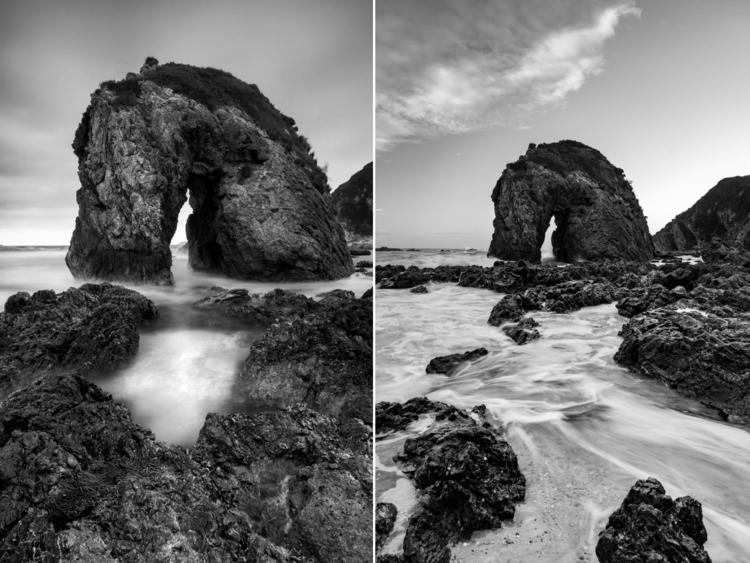
Horse Head Rock at Bermagui, New South Wales is one of my favourite places to shoot. While I'm happy with the shot on the left, 24mm wasn't quite wide enough for me. So, I had to rethink my composition and come home with a shot I wouldn't have otherwise.
Caring for a Workhorse Lens in the Field
When an entire kit depends on a single piece of glass, maintenance isn't optional — it's mission-critical. A scratched front element or jammed focus ring means the entire shoot is over. Our team treats our primary lens like the irreplaceable tool it is.
Cleaning Routine
A solid cleaning protocol keeps the lens performing at its best:
- Use a rocket blower before every shoot to clear dust from the front element and rear mount
- Carry a LensPen (brush end first, then the carbon tip) for smudges and fingerprints
- Wipe the barrel and focus ring with a microfiber cloth after coastal or dusty shoots
- Inspect the rear element monthly — this is where sensor-bound dust originates
- Store in a dry cabinet or with silica packets between outings
Since the lens never comes off the body in the field, sensor contamination drops to nearly zero. This is one of the most underappreciated benefits of the one lens landscape photography approach. Anyone who has dealt with stubborn sensor spots during post-processing knows the frustration — and relief — this eliminates.
Weather and Impact Protection
Landscape work means exposure to rain, salt spray, sand, and temperature extremes. Our protection strategy is straightforward:
- Always use a UV or clear filter as a sacrificial front element — replace it, not the lens
- A quality filter system like the NiSi V5 Pro doubles as physical protection when using ND or polarizer filters
- Carry a rain sleeve (even on clear days — weather turns fast in mountains and coastal areas)
- Use a neoprene lens wrap for impact protection during hikes
The reality is that one lens gets used harder than any single lens in a multi-lens kit. It's out in every condition, mounted for every shot. Treat it accordingly.
Choosing the Right Lens for Single-Lens Landscapes
Not every lens suits the one-lens philosophy equally. Our team's recommendations lean heavily toward primes, though quality zooms used at a fixed focal length work too.
Focal Length Comparison
Here's how different focal lengths perform for dedicated landscape use with a single lens:
| Focal Length | Field of View | Best For | Limitations | Our Rating |
|---|---|---|---|---|
| 16-20mm | Ultra-wide | Dramatic skies, tight spaces | Distortion, tiny subjects | ★★★☆☆ |
| 24mm | Wide | General landscapes, architecture | Mild distortion at edges | ★★★★☆ |
| 28mm | Moderate wide | Versatile all-rounder | Not wide enough for some vistas | ★★★★☆ |
| 35mm | Standard wide | Natural perspective, storytelling | Requires panoramas for wide scenes | ★★★★★ |
| 50mm | Standard | Intimate landscapes, details | Too narrow for grand scenes | ★★★☆☆ |
| 85-135mm | Short telephoto | Compressed layers, abstracts | Very specialized | ★★☆☆☆ |
Our team's pick is the 35mm prime, without hesitation. It renders perspective the way the human eye naturally sees — no distortion pulling the viewer out of the image, and enough width to capture meaningful scenes. When stitched into panoramas, it produces files that rival medium format in resolution and detail.
Filters and Accessories
A single lens simplifies the accessory kit dramatically. One filter set, one lens hood, one cap. Here's what our team carries alongside the lens:
- Circular polarizer — non-negotiable for controlling reflections and deepening skies
- 6-stop ND filter for long exposures in daylight
- 3-stop graduated ND for balancing bright skies against dark foregrounds
- A solid tripod — the money saved on extra lenses goes here
The financial argument is worth stating bluntly. A single premium prime (like a 35mm f/1.4) costs less than two mediocre zooms. The image quality from one great lens outperforms a bag full of compromises every time. The savings extend to filters too — one set of 77mm filters versus three different sizes with step-up rings and adapters. Photographers who shoot locally rather than travelling will find the streamlined kit makes it easier to get out the door for quick sessions.
Frequently Asked Questions
Is one lens landscape photography suitable for professionals?
Absolutely. Many working landscape photographers, including several whose work our team admires, shoot commercially with a single prime lens. The consistency of output and the distinctive "look" that comes from mastering one focal length can actually become a professional advantage — clients recognize and hire for that specific visual style.
What if a scene genuinely requires a wider or longer lens?
Panorama stitching solves the wide end beautifully. For telephoto compression, cropping a high-resolution file from a sharp prime yields excellent results. Our team has printed panoramas from a 35mm lens at 40 inches wide with stunning detail. The key is shooting in RAW to preserve maximum data for cropping and stitching.
Should the one lens be a prime or a zoom?
Our team strongly favours primes. They're sharper, lighter, faster in aperture, and — critically — they remove the temptation to zoom. A zoom taped at 35mm is functionally identical to a prime at 35mm, but primes tend to have superior optical performance and build quality at equivalent price points.
How does one lens landscape photography work with different camera systems?
The focal length recommendations assume full-frame sensors. For APS-C, multiply by 1.5x (so a 23mm gives the 35mm equivalent). For Micro Four Thirds, multiply by 2x (so a 17mm gives the 35mm equivalent). The principle of constraint remains identical regardless of sensor size.
Does using one lens get boring over time?
The opposite, in our experience. Constraints spark creativity. When the lens can't change, the photographer must change — finding new angles, new light, new relationships between foreground and background. Our team consistently finds that single-lens outings produce more creative and surprising results than multi-lens sessions where the temptation is to "zoom and shoot" from one spot.
Next Steps
- Open Lightroom and review the EXIF data from the last 200 landscape shots — identify which focal length dominates the keepers, then commit to shooting exclusively at that length for the next five outings.
- Pick one familiar location — ideally somewhere like a local beach or park visited before — and shoot an entire session with a single lens. Focus on moving physically rather than zooming, and compare the results against previous multi-lens visits.
- Invest the money saved from not buying extra lenses into a quality circular polarizer and a 6-stop ND filter for the chosen focal length — these two accessories will expand creative range far more than an additional lens body ever could.
- Practice the panorama stitch technique: shoot three overlapping vertical frames with 30% overlap at the chosen focal length, then merge them in Lightroom or Photoshop to produce ultra-wide, high-resolution files that rival dedicated wide-angle glass.
 |
 |
 |
 |

About Alex W.
Alex is a landscape, equine, and pet photographer based in the Lake District, UK, with years of experience shooting in one of Britain's most photographically demanding natural environments. His work has been featured in Take a View Landscape Photographer of the Year, Outdoor Photographer of the Year, and Amateur Photographer Magazine — publications that reflect a serious, competitive standard of image-making. At Click and Learn Photography, he shares the camera settings, gear choices, and compositional techniques he has developed through real-world shooting and competition-level work.
You can Get FREE Gifts. Furthermore, Free Items here. Disable Ad Blocker to receive them all.
Once done, hit anything below
|
|
|
|